
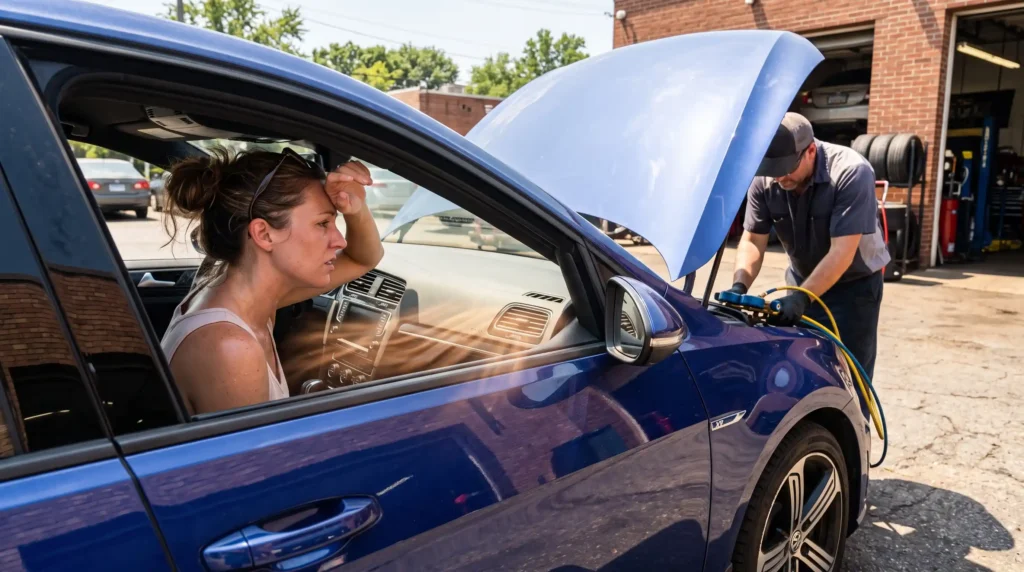
If your car’s AC is blowing warm air, the usual suspects are low refrigerant, a refrigerant leak, a compressor or compressor-control problem, poor condenser airflow, or an electrical fault.
Some of these you can check yourself. Some you should not touch.
I’ve worked on enough AC and electrical problems to know that the first suspected part is often not the real problem. A driver thinks the compressor is dead, but the actual issue turns out to be a fuse, relay, wiring fault, low refrigerant charge, or a cooling fan that stopped working.
So before you start replacing expensive parts, start with the symptoms. They’ll narrow things down fast.
Table Of Contents
Table of Contents
First: Did It Fail Suddenly or Fade Over Time?
This one question tells you a lot.
- If the AC got weaker over weeks or months, low refrigerant from a leak is a strong possibility.
- If it stopped cooling overnight, think electrical: fuse, relay, pressure sensor, compressor clutch, or a control problem.
- If it’s cold while driving but warm at idle, condenser airflow is a prime suspect.
- If the fan blows hard but the air is warm, the blower is fine. The refrigeration side or the blend door is the problem.
- If one side is cold and the other is warm, suspect a blend-door actuator or an HVAC control issue.
None of these symptoms gives you a guaranteed diagnosis. But they stop you from guessing.
Safe Checks You Can Do Yourself
1. Check the AC fuse and relay
A blown fuse or bad relay can stop the compressor from running.
Check your owner’s manual for the right fuse box location and amperage. If it’s blown, replace it with the same rating. If the new fuse blows again, stop. You have a short or another electrical fault that needs proper diagnosis.

2. See if the compressor is engaging
On many cars with a clutch-style compressor, you’ll hear or see the clutch click on when the AC is commanded.
With the engine running, set the AC to max cold. Look at the compressor. Does the center part spin? Does the clutch engage?
But don’t assume a compressor that won’t engage is bad. The car may be blocking it because of low refrigerant pressure, a faulty pressure sensor, a wiring problem, or another control fault.
3. Check the cabin air filter and airflow
A clogged cabin filter usually causes weak airflow, not warm air. Still worth checking. If the blower is weak, start there.
4. Check the condenser and cooling fan
The condenser sits near the front of the car. It needs airflow to release heat.
With the AC on, the condenser fan should run. If it doesn’t, the system can’t shed heat—especially when you’re stopped.
Also look at the condenser itself. Bugs, leaves, dirt, and bent fins restrict airflow. Clean it gently. Don’t mash the fins.
5. Check for blend-door problems
If the refrigeration system is working but warm air still comes out, the problem may be inside the dash.
A blend door or its actuator controls whether air passes through the heater core or the evaporator. If it sticks or fails, you can get warm air even with a perfectly good AC system.
Car AC Not Cooling but the Fan Is Running
This is common. You feel plenty of air, but it isn’t cold.
Remember: the blower fan and the AC system do different jobs. The blower can work perfectly while the AC does nothing.
Possible causes:
- Low refrigerant
- Refrigerant leak
- Compressor or compressor-control problem
- Condenser airflow problem
- Cooling fan failure
- Blend-door or HVAC control problem
- Electrical fault
Don’t just add refrigerant. If it’s low, it leaked. Find the leak first.
Car AC Gets Cold While Driving but Warm at Idle
This symptom is a big clue.
If the AC is cold on the highway but warm at a stoplight, check condenser airflow first.
At road speed, natural airflow moves through the condenser. When you’re stopped, the cooling fan has to do that job. If the fan is dead, weak, or not getting power, the AC will struggle at idle.
A dirty or restricted condenser makes it worse.
Don’t automatically assume you need refrigerant. This is often a fan, relay, fuse, wiring, or condenser problem.
Car AC Not Cold Enough in Hot Weather? Here’s Why
AC systems work harder when it’s brutally hot outside. A car that feels okay on a mild day may struggle in direct sun on a 100-degree afternoon.
That doesn’t always mean something is broken.
Use recirculation mode
Once the worst of the hot air is out, switch to recirculation. That cools the air already inside the cabin instead of constantly pulling in hot outside air.
A windshield sunshade also helps while parked.
Check condenser airflow
If the cooling fan isn’t working correctly, the AC will struggle at low speeds and on hot days.
Inspect the front of the condenser for dirt, leaves, and insects. Clean carefully.
Consider the refrigerant charge
A system that’s slightly low may still cool a little but fall apart in high heat.
Don’t guess by adding a can. The correct charge depends on the vehicle. Checking it properly requires the right equipment.
Car AC Not Blowing Cold Air After a Recharge? Something’s Wrong
If you recharge the AC and it gets cold for a short time but then turns warm again, do not just recharge it again.
That pattern usually means a leak. It could also mean the wrong charge amount, a compressor problem, a control fault, or another issue. But repeatedly topping it off is not a repair.
A proper diagnosis may include:
- Checking high-side and low-side pressures
- Looking for visible leaks
- Using an electronic leak detector or UV dye
- Checking compressor operation
- Checking condenser airflow
- Checking electrical controls and sensors
- Verifying the correct refrigerant type and amount
Do not open pressurized AC lines yourself. Refrigerant can cause severe cold burns and eye injuries. In many places, handling refrigerant also requires certification, and venting it is illegal.
How Your Car’s AC Actually Works
You don’t need to be an AC technician, but understanding the basics helps.
Compressor
The compressor circulates refrigerant and raises its pressure. It may use a traditional clutch or an electronic control system, depending on the car.
Condenser
The condenser is usually in front of the radiator. It releases heat and turns high-pressure gas into high-pressure liquid. It needs airflow.
Expansion device
This is an expansion valve or orifice tube. It drops refrigerant pressure before the evaporator.
Evaporator
The evaporator is inside the dash. Refrigerant absorbs heat from the cabin air. The blower then pushes that cooled air through the vents.
Receiver-drier or accumulator
Depending on the system, this component manages refrigerant and removes moisture.
If any part of that loop fails, or if refrigerant leaks out, you get warm air.
A Simple Way to Narrow Down the Problem
Don’t replace parts randomly. Work through the symptom.
No airflow from the vents?
Check the blower motor, blower resistor or control module, fuse, wiring, and cabin air filter.
Strong airflow but warm air?
Check compressor operation, refrigerant charge, condenser airflow, and HVAC temperature control.
Cold while driving but warm at idle?
Check condenser airflow and the cooling fan.
AC got weaker gradually?
Investigate for a refrigerant leak.
AC got warm right after a recharge?
Check for a leak, incorrect charge, or another system fault. Don’t just add more refrigerant.
One side cold, one side warm?
Suspect a blend-door problem, HVAC control issue, or refrigerant-related fault, depending on the vehicle.
When You Should Stop DIY Troubleshooting
Get professional help if:
- You suspect a refrigerant leak
- The system needs to be evacuated and recharged
- The compressor has failed
- You need to open the refrigerant circuit
- Pressures are unusually high or low
- A cooling fan or electrical fault needs deeper diagnosis
- You’re not sure which refrigerant your car uses
Never open a pressurized AC line just to see what’s inside.
What It Might Cost
Prices vary a lot by vehicle and shop. These are rough U.S. ballparks:
- AC diagnosis: $100–$200
- Recharge with leak check: $150–$300
- Compressor replacement: $500–$1,200+
- Condenser fan: $200–$600
- Blend-door actuator: $200–$800, depending on dash labor
- Leak repair: varies widely based on location and parts
Call a local shop for a real quote. Don’t trust one online number.
FAQs
Can low refrigerant cause warm air?
Yes. If the charge is too low, the AC can’t cool properly. But if it’s low, it leaked. The system should be checked for a leak instead of repeatedly topped off.
Why is my AC cold while driving but warm at idle?
Poor condenser airflow is a leading suspect. A cooling fan problem can stop the condenser from releasing heat when the car is stopped.
Why is my AC still warm after a recharge?
You may have a leak, the wrong charge amount, a compressor problem, a control fault, or another issue. If it gets warm again soon after a recharge, have it diagnosed.
How do I know if my AC compressor is working?
It depends on the design. On many cars, you can hear or see the clutch engage. But a compressor that won’t engage isn’t automatically bad. Low pressure, electrical faults, sensors, and control issues can all prevent engagement.
Final Thoughts
When your car AC stops blowing cold air, don’t jump straight to “bad compressor.”
Start with the symptoms. Check the simple electrical stuff first. Pay attention to whether the problem came on suddenly or gradually, whether it’s colder while driving, and whether the compressor and cooling fan are doing their jobs.
If the system is low on refrigerant, don’t treat that as a simple top-off. A low charge usually means there’s a leak.
Pingback: 5 Reasons Why Car Blower Motor Only Works on High Setting