
After 17 years working with electrical systems, I’ve seen how often wrong headlight use causes avoidable accidents.
That moment in the driver’s seat, fingers on the stalk, dusk settling in, shouldn’t feel like a test. But when you’re twisting from one mysterious icon to another, hoping you’ve chosen right, that hesitation means something. It’s your car speaking a language you haven’t quite learned yet.
That cluster of headlight symbols isn’t just dashboard decoration. It’s a critical safety conversation. Getting it wrong can blind an oncoming driver or leave you invisible in the rain.
Here at HelpMechanic, we translate your car’s secret code into plain, friendly advice. No jargon, no dense manuals. Let’s start with the most important icons: your headlight symbols. Consider this your decoder ring. Let’s make sure you’re seen and safe every time you drive.
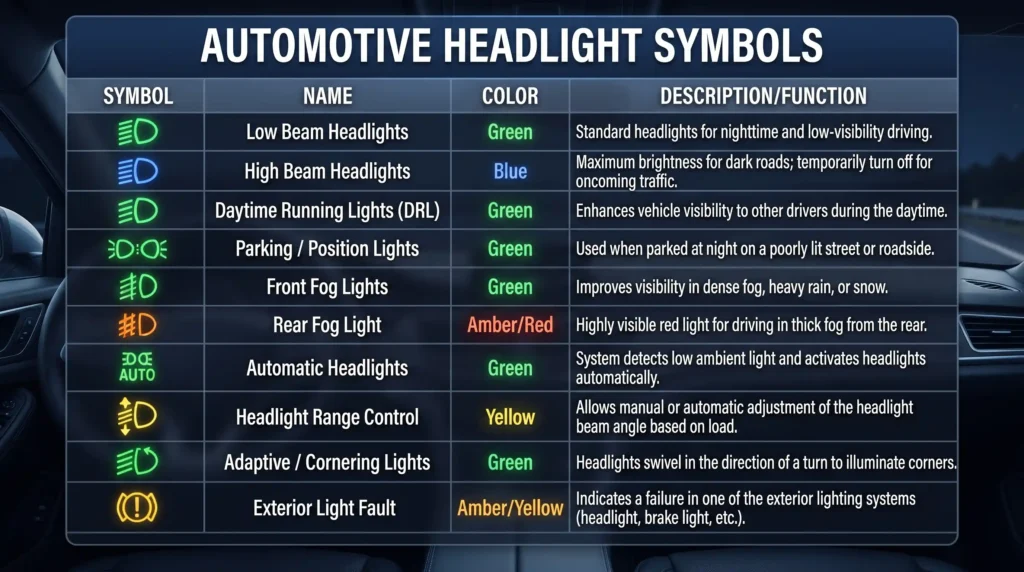
The Headlight Symbol Cheat Sheet: What They Mean & When to Use Them
1. The “Lights Off” Symbol:
- Symbol: (Often an “O” or a circle)
- When to Use It: Only during bright, clear daylight conditions. The moment the light starts to fade, or you enter a tunnel, it’s time to switch on. Remember, many modern cars have “Daytime Running Lights” (DRLs) that may stay on in this position, but these are not tail lights. You might be invisible from behind at dusk.
2. Side Lights / Parking Lights:
- Symbol: Two small, green lamps pointing outward.
- When to Use It: Think of these as your car’s “standby” mode. They power your tail lights, license plate light, and sidelights, but not your headlights. Use them if you’re parked on a dimly lit road to make your car visible, or temporarily in very low light conditions where full headlights feel excessive. Pro Tip: They are not for driving in darkness.
3. Dipped Beam / Low Beam Headlights:
- Symbol: A green lamp symbol with lines sloping down and to the left.
- When to Use It: This is your default setting for all night-time driving and any poor visibility (rain, fog, snow, dawn, dusk). The beam is angled down to light the road without dazzling oncoming traffic. If you can’t see the sun, these should probably be on.
4. Main Beam / High Beam Headlights:
- Symbol: A blue lamp with lines pointing straight ahead.
- When to Use It: For unlit country roads or motorways with no oncoming traffic in sight. The moment you see another car’s taillights (in front of you) or headlights (approaching you), you must switch back to dipped beam. That blue symbol on your dash is your reminder that you have a powerful tool engaged: use it responsibly.
5. Front and Rear Fog Lights:
- Symbol:
- Front Fog Lights: A green lamp with lines pointing down, with a wavy line through them.
- Rear Fog Light: An amber lamp pointing to the right, with a wavy line and a line through it (it often looks stronger than the tail light symbol).
- When to Use It: Only in seriously reduced visibility where you can’t see more than 100 meters ahead, such as thick fog, heavy snow, or torrential rain. They are intensely bright to cut through the gloom. Crucial: Turn them off as soon as conditions improve. That blazing rear fog light can be dazzling and mask your brake lights in normal conditions.
6. Headlight Beam Height Adjuster:
- Symbol: A dial or button with a pictogram of a car and numbered lines.
- When to Use It: If your car is heavily loaded (with passengers in the back or a full trunk), your headlights can be tilted upward and blind others. Dial this down a setting or two to compensate. No load? Set it to “0”.
7. Headlight Failure Warning:
- Symbol: An exclamation mark inside a headlight icon, often in amber or red.
- What It Means: A bulb is likely out. Don’t ignore it. Driving with a headlight out is dangerous, illegal, and will likely fail your vehicle inspection. It’s time to visit a mechanic or, if you’re feeling handy, consult a HelpMechanic guide on bulb replacement.
Headlight Symbols At a Glance

Here’s your quick-reference table. Keep it handy next time you’re unsure which icon to choose.
| Symbol (Description) | What It Means | When To Use It |
|---|---|---|
| O (Often a circle) | Lights Off | Bright, clear daylight only. Switch on as soon as light fades. |
| Two small green lamps | Parking / Side Lights | For making a parked car visible. Not for driving in the dark. |
| Green lamp, lines sloping down-left | Low Beam / Dipped Beam | Your default for all night driving, rain, fog, or low light. |
| Blue lamp, lines straight ahead | High Beam / Full Beam | Dark, empty roads only. Must switch off for other traffic. |
| Green lamp with a wavy line through it | Front Fog Lights | Only in thick fog, heavy snow, or torrential rain. |
| Amber lamp with wavy line | Rear Fog Light | Severe visibility loss (<100m). Crucial: Turn off after. |
| Dial with car & numbered lines | Headlight Level Adjuster | Adjust when car is heavily loaded to prevent blinding others. |
| ! inside a headlight icon | Headlight Failure Warning | A bulb is out. Needs immediate attention to stay legal and safe. |
This table is your dashboard cheat sheet. Use it to drive with confidence, day or night.
FAQs: Quick Headlight Answers
What headlights should I use?
Use low beams (sloped lines) for most nights and poor weather driving. High beams (blue icon) are for dark, empty roads only. Switch back when you see other cars.
When can I use brights?
Only on completely dark roads with no other traffic in sight. Switch to low beams the moment you see another car’s lights.
What are the headlight bulb types?
Four main kinds:
- Halogen: Classic, affordable.
- HID/Xenon: Bright white/blue light.
- LED: Crisp white, efficient, long-lasting.
- Laser: Top-tier range (high-end cars).
Are LEDs brighter than HID?
HIDs can have more raw output, but LEDs appear brighter and whiter to our eyes due to focused light. LEDs are the modern, efficient choice.
Final Thoughts: Drive Confidently, Drive Safely
Drive with confidence. You’ve just learned the language of light your car speaks. From the gentle glow of parking lights to the long reach of the high beam, you’re now in full command.
Using the right light at the right time is the mark of a truly skilled driver. It shows care for your safety and consideration for everyone else on the road.
You’re not just driving. You’re communicating.
Made sense? Brilliant. Now, if your dashboard still has a symbol you can’t crack, don’t ignore it. Let’s fix it.
Drop your question in the comments. I read every one, and I’m here to help.