
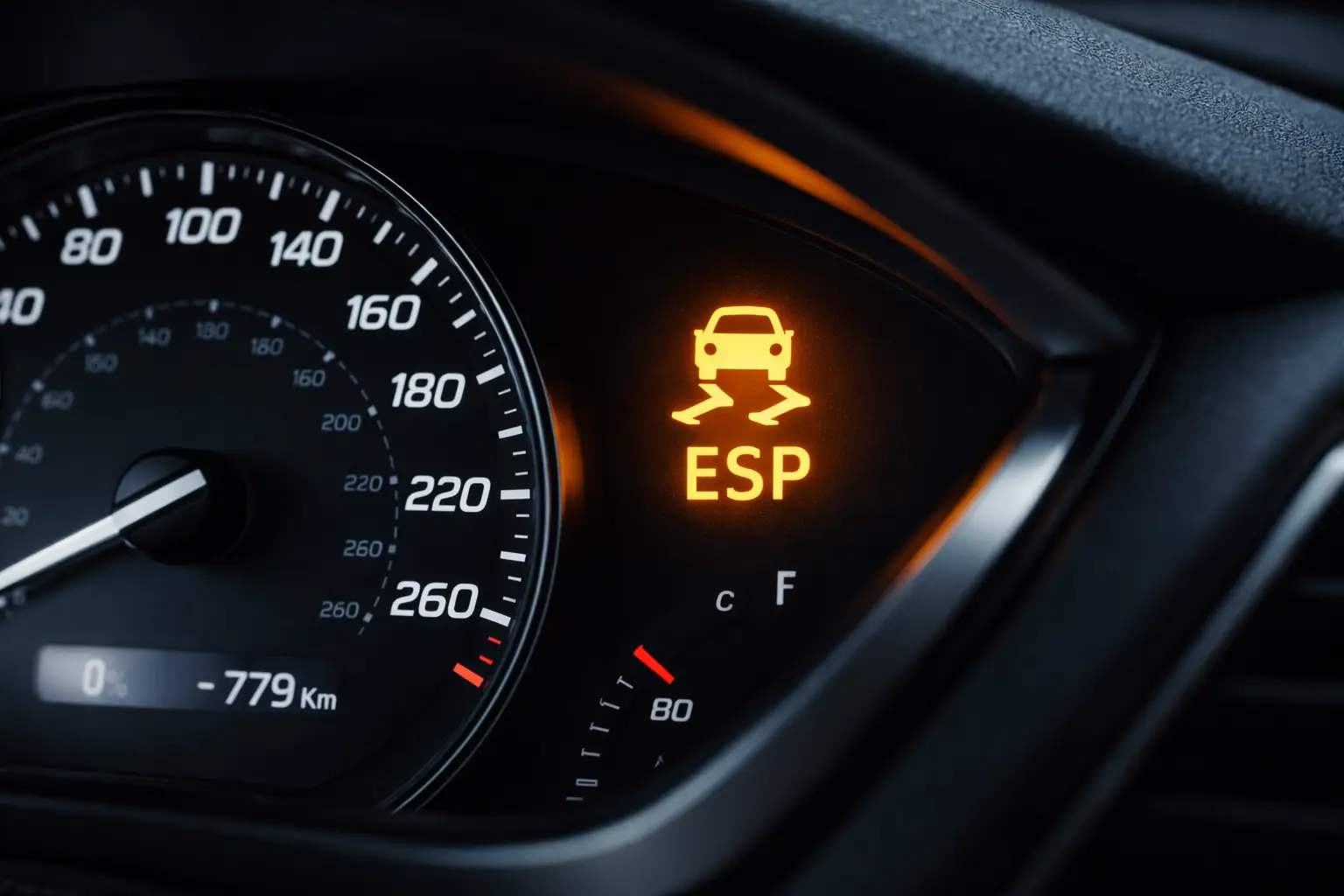
If you’ve ever glanced at your dashboard and seen the letters “ESP” illuminated, perhaps with a little car skidding symbol, you might have asked this question: What does ESP mean? ESP means Electronic Stability Program.
It’s a safety system designed to help you keep control of your car when it starts to skid, slide, or lose traction, especially during sharp turns, sudden braking, wet roads, or emergency maneuvers.
In simple terms:
👉 ESP helps prevent your car from spinning or drifting when things go wrong.
As an electromechanic with 17 years of hands-on experience, I can tell you this straight: ESP has prevented countless accidents. Many drivers never even realize it stepped in to save them.
Table of Contents
How to Turn On ESP in Your Car
Here’s the good news: ESP is always ON by default every time you start your engine. You don’t need to manually activate it for daily driving. The system is in a constant state of readiness, monitoring your steering input, wheel speed, and vehicle direction dozens of times per second.

However, there are times when the system might be temporarily switched off. If so, turning it back on is straightforward:
- Look for the Button: The ESP button (often showing the icon of a car with swerving lines) is typically located on the center console or dashboard.
- Press to Enable: Simply press the button. You will usually see a brief confirmation light on your instrument cluster saying “ESP ON” or, more commonly, the ESP warning light will turn off, indicating the system is active.
Professional Tip: For 99% of driving conditions: rain, snow, highway curves, you want ESP engaged. It intervenes so smoothly you might not even feel it, perhaps just noticing a slight pulsing from the brakes or a reduction in engine power as it works to correct a slide.
How to Turn Off ESP in Your Car & Why You Might (With Brand Examples)
There are specific, limited scenarios where temporarily disabling ESP can be beneficial. The process is the same across most brands: press and hold the ESP button for a few seconds (usually 3-5) until you see a persistent ESP OFF or related warning light on the dashboard.
Why turn off this vital safety net?

- Deep Snow, Sand, or Mud: If you are stuck, spinning the wheels (which ESP actively tries to prevent) can sometimes help you “dig out” and find traction.
- Performance Driving on a Track: Advanced drivers on a closed circuit may want to disable ESP to execute controlled drifts or explore the car’s limits without electronic intervention.
- Using Snow Chains: ESP can misinterpret the slight wheel speed variations caused by chains.
How Brands Label It:
- Volkswagen, Audi, Mercedes-Benz: It’s universally called ESP.
- BMW, Mazda, Jaguar: They often use the acronym DSC (Dynamic Stability Control).
- Toyota, Lexus: They typically call it VSC (Vehicle Stability Control).
- Honda, Acura: Uses VSA (Vehicle Stability Assist).
- General Motors (GM): Often uses StabiliTrak.
- Ford, Land Rover: Uses ESC (Electronic Stability Control), the standardized global term.
A Crucial Caveat from the Garage: I always advise my clients: if you turn ESP off to get unstuck, turn it back on immediately once you’re free. Driving on public roads with it disabled removes a key layer of protection.
What Causes the ESP Light to Come On?
The ESP light can illuminate in two distinct ways, and understanding the difference is key:

- Solid ESP Light: This typically indicates you have manually turned the system OFF.
- Flashing ESP Light: This is the system in ACTION. It flashes while it is actively applying brakes or managing throttle to correct a skid. This is normal and indicates it’s working hard.
- Solid ESP Light + ABS/Other Warning Lights: This is a warning of a fault. The system has detected a problem and has deactivated itself for safety. Common culprits include:
- Faulty Wheel Speed Sensor: The most common issue I see. This sensor is the system’s “eyes,” telling it how fast each wheel is spinning. Dirt, damage, or failure can blind it.
- ABS Module/System Fault: ESP works through the Anti-lock Braking System (ABS). A problem with the ABS pump, ring, or module will disable ESP.
- Faulty Steering Angle Sensor: This tells the computer where you intend to steer. If it’s misaligned or broken, the ESP can’t know your intended direction.
- Low Brake Fluid or Worn Brakes: Can affect hydraulic pressure needed for ESP operation.
- A Simple Glitch: Sometimes, a temporary voltage drop or software hiccup can trigger the light.
How to Fix ESP on a Car: A Methodical Approach
Fixing an ESP fault requires a systematic diagnosis. Here’s the approach I take in my workshop:

- Start with the Simple Stuff:
- Check Your Brake Fluid Level. A low reservoir can trigger multiple warnings.
- Ensure Your Tire Pressures are correct and even. A significantly underinflated tire can mimic a wheel speed issue.
- Perform a Hard Reset. Disconnect the car’s battery for 10-15 minutes. This can clear temporary electronic glitches. (Note: You may lose radio presets).
- Read the Fault Codes: This is the essential next step. Use an OBD2 scanner that can read chassis/ABS codes (not just engine codes). A code like C0121 will point directly to a left-front wheel speed circuit, for example. Without a code reader, you’re guessing.
- Common Repairs Based on Codes:
- Wheel Speed Sensor Replacement: A frequent fix. Sensors can be contaminated with metallic brake dust or fail internally.
- Tone Ring Inspection: The sensor reads from a notched ring on the axle or wheel bearing. These can crack or become clogged with debris.
- Steering Angle Sensor Recalibration: Often required after a wheel alignment or battery disconnect. This usually requires a scanner with specific calibration functions.
- ABS Module Repair/Replacement: A more complex and costly repair, sometimes involving soldering or replacement.
Expert Advice: Don’t ignore a persistent ESP fault. While the car may drive “normally,” you’ve lost a major safety system. The repair is often less expensive than the single accident it could have prevented.
ESP & Your Car: Frequently Asked Questions (FAQs)
Can I drive my car if the ESP light is on?
If the light is solid and on with other warning lights (like ABS), you can drive, but do so with extreme caution. Your car’s stability and traction control are disabled. Avoid harsh maneuvers, drive slower, and get it diagnosed promptly. If the light is flashing, that’s normal; it means the system is actively working.
How often does ESP engage?
More often than you think.
ESP activates silently and briefly, especially:
- On wet roads
- During quick lane changes
- In sharp turns
Most drivers never notice it working.
Is an ESP fault serious?
Yes, from a safety perspective.
While the engine may run fine, loss of stability control increases accident risk, especially at highway speeds.
How do I reset the ESP light?
Sometimes:
- Turn steering wheel fully left and right
- Restart the engine
- Disconnect the battery (short-term fix only)
⚠️ If the light comes back, a fault is stored and must be diagnosed.
What is the difference between ESP and ABS?
ABS (Anti-lock Braking System) prevents your wheels from locking up during hard braking, allowing you to steer while stopping. ESP (Electronic Stability Program) is a more advanced system that uses the ABS hardware. ESP can apply braking force to individual wheels and reduce engine power to correct a skid during any kind of maneuver, not just braking. Think of ABS as a specialist for braking, and ESP as the overall stability manager.
Final Thoughts: Your Electronic Co-Pilot
Consider your car’s ESP its unwavering co-pilot. As an electromechanic of 17 years, I’ve witnessed how this brilliant system quietly averts disaster on slick roads. It’s a guardian you must trust.
My professional advice is simple: trust it and maintain it. Start every journey with ESP active. Respect its dashboard warning light; it’s a critical alert that your safety net is down, often due to a simple, fixable issue like a dirty sensor. Your role is straightforward: keep ESP on, ensure your tires and brakes are in good shape, and let this brilliant engineering do its silent work.
But what’s your specific situation? Does your light stay on, or do you feel a hiccup when cornering in the rain? Tell me exactly what you’re experiencing in a comment below. I’m here to help you decode it.