
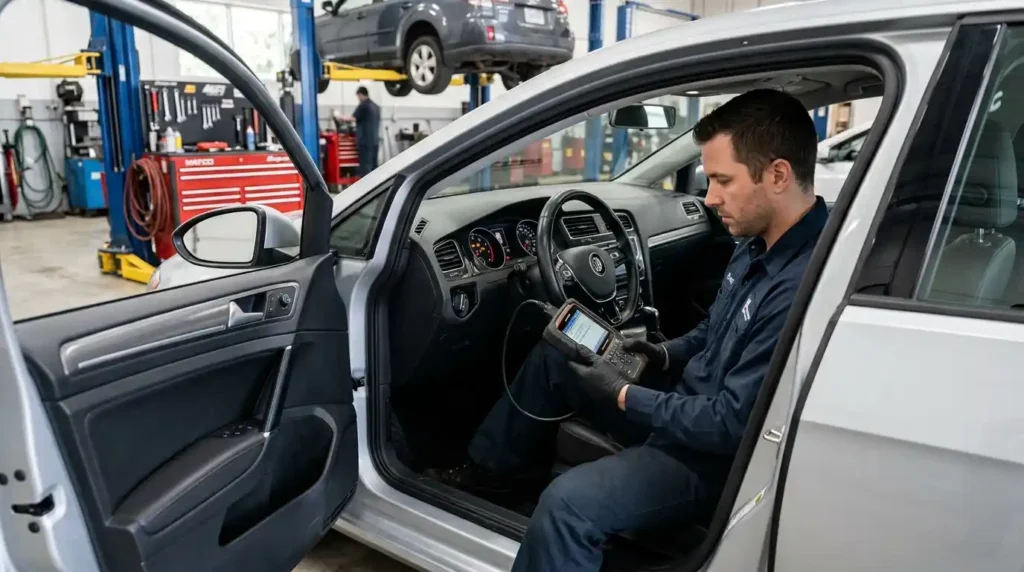
Is your ABS light on? I know exactly what’s going through your head right now because I’ve had this conversation a hundred times.
Let me stop you right there.
You can probably still drive. Your normal brakes don’t care about the ABS system. They work independently. So when you hit the pedal, you’ll stop. That part’s not the problem.
Here’s what you lost, though. That anti-lock function? It’s the thing that keeps your wheels from locking up and sliding when you brake hard. Without it, you can still stop; you just can’t steer while you’re doing it on a slippery road. Without ABS, your wheels lock, you slide, and turning the wheel does nothing. That’s the difference.
So yeah. Drive to work if you have to. Just leave way more room than you normally would and take it easy. Don’t ignore it, though. Get it looked at. Sooner is cheaper than later with this stuff.
Table of Contents
First Thing I’d Tell You To Do

Before you buy anything, before you start watching YouTube videos about replacing ABS modules, get the codes scanned.
And I mean scanned properly. That cheap code reader you’ve got in your glovebox? It won’t read ABS codes. You need a scan tool that talks to the ABS computer. Most shops charge $80 to $150 for this. Takes them maybe thirty minutes.
Why does this matter so much?
Because the light doesn’t tell you what’s broken. It just tells you something’s broken. The codes tell you which wheel, which sensor, which wire. Without them, you’re just guessing. And guessing gets expensive fast.
I’ve seen people drop six hundred bucks on a new ABS module when the real problem was a dirty sensor they could’ve cleaned for free.
What’s Actually Wrong (In Order of How Often I See It)
Wheel Speed Sensor: The One I’d Bet On

If you made me guess before I even looked at your car, I’d say wheel speed sensor. Every single time.
These little guys live down by your wheels. They get blasted with road salt, mud, brake dust, metal shavings everything. When the tip gets coated or the inside coil dies, the ABS computer loses track of that wheel. No data means no ABS. The light comes on.
Cost to fix? Usually $150 to $400 per wheel, depending on your car.
Can you do it yourself? Sometimes. If it’s just dirty, pull it out, hit it with brake cleaner, and put it back. If it’s dead, it’s usually one bolt and a connector. Not hard.
Wheel Bearing: The Noise You’ve Been Ignoring
A worn wheel bearing lets the wheel wobble. That messes with the sensor gap. The ABS computer sees garbage data and shuts the whole system down.
You probably heard this one coming. That hum or growl from one corner that gets louder when you turn. If you’ve been cranking the radio to drown it out, that’s on you.
Cost to fix? $250 to $650 per wheel. The bearing is usually pressed into the hub. Special tools needed.
DIY? Only if you own a hydraulic press and enjoy pain.
Tone Ring: The Rusty Gear Thing
The tone ring is the toothed ring that the sensor reads. Rust, cracks, missing teeth. Any of that equals a bad signal.
Cost? $200 to $650 depending on whether it’s a separate part or built into the hub.
Wiring or Connector: The Hidden Problem
The wires going to your wheel sensors live in hell. Road salt eats them. Debris rubs through them. Water gets inside the connectors.
If your ABS light comes and goes, flickers on when you hit bumps, or shows up after rain, this is probably your issue.
Cost? $100 to $500 depending on how bad it is.
Low Brake Fluid: The Indirect Brake Pad Thing
Here’s where I need to clear something up because there’s a lot of nonsense online about this.
Worn brake pads do not directly cause your ABS light to come on. That’s not how it works.
But here’s the real connection. When your pads wear down, the calipers have to extend further. That pulls more fluid out of the reservoir. Over time, the level drops. If it drops too low, the ABS light can come on because the system needs hydraulic pressure to do its job.
So yes, worn pads can be part of the story. They’re just not the main character.
Cost? Free to $150 for a fluid top-off and inspection. If you need pads too, add $150 to $400.
ABS Module or Pump: The One You Don’t Want
This is the brain of the system. When it dies, your wallet feels it.
Cost? $500 to $1,300+ for the module. The hydraulic pump unit? $700 to $1,500+.
Red flag: if your ABS light AND traction control light are both on, and the scan tool can’t even talk to the ABS module, that’s probably where you’re headed.
What It Costs (Quick Look)
| Problem | How Common | Cost | DIY? |
|---|---|---|---|
| Wheel speed sensor | Very common | $150-$400 | Yes, if handy |
| Wheel bearing | Common | $250-$650 | No |
| Tone ring | Moderate | $200-$650 | Sometimes |
| Wiring/connector | Moderate | $100-$500 | Yes, if accessible |
| Low brake fluid | Less common | Free-$150 | Yes |
| ABS module/pump | Less common | $500-$1,500+ | No |
These are rough U.S. dollar estimates. Actual repair costs vary significantly by vehicle, parts, labor rates, and location.
What Should You Check First If the ABS light has just appeared?
Step 1: Check the Other Warning Lights
Look at the dashboard.
Is it only the ABS light?
Or are you also seeing:
- Red BRAKE warning
- Traction-control light
- Stability-control light
- Check engine light
- Battery/charging warning
The combination can provide useful clues.
Step 2: Check the Brake Fluid
Park the vehicle safely on level ground and check the brake-fluid reservoir.
The level should be within the manufacturer’s specified range.
If it’s low, find out why before simply adding more fluid.
Use only the brake-fluid specification listed by the vehicle manufacturer.
Step 3: Inspect the Wheel-Speed Sensor Wiring
Look around each wheel for obvious problems.
Check for:
- Broken wires
- Damaged insulation
- Loose connectors
- Corrosion
- Wiring pulled tight
- Evidence of rubbing against a tire or suspension component
Don’t pull or disconnect components unnecessarily.
Step 4: Scan the ABS Module

This is one of the most important steps.
A basic OBD-II reader that only reads engine/powertrain codes may not be able to communicate with the ABS module.
You need a scan tool with ABS diagnostic capability for the vehicle.
The stored diagnostic trouble code can point you toward the affected circuit or system.
But remember:
A code is a starting point, not always a parts-ordering instruction.
For example, a wheel-speed sensor code may ultimately be caused by the sensor, wiring, connector, tone ring, bearing, or hub.
Step 5: Check Live Wheel-Speed Data
If the scan tool supports it, compare the wheel-speed readings while the vehicle is operated according to the manufacturer’s diagnostic procedure.
A wheel that suddenly drops to zero or reports an implausible speed can help identify the problem.
This is often much more useful than simply guessing which sensor to replace.
Step 6: Inspect the Tone Ring, Hub, and Bearing
If the sensor and wiring appear good, inspect the mechanical parts that affect the signal.
Depending on the vehicle, that can include:
- Tone/reluctor ring
- Wheel bearing
- Hub
- Sensor mounting area
- Magnetic encoder
This is where vehicle-specific service information becomes important.
Questions I Get Every Day
Will new brake pads fix my ABS light?
Usually not. Brake pads don’t normally cause an ABS warning by themselves. Low brake fluid or another brake-system issue can sometimes be involved, but a wheel-speed sensor, wiring fault, bearing, or ABS problem may be the real cause.
How much to fix an ABS light?
It depends on what’s causing it. A wheel-speed sensor repair may be around $150–$400, while an ABS module or hydraulic unit can cost $500–$1,500 or more. Diagnosis should come before buying parts.
Can I just clear the ABS code?
You can clear the code on many vehicles, but that doesn’t repair the problem. If the fault is still present, the warning will usually return.
Does an ABS light mean my brakes are failing?
Not necessarily. If it’s only the amber ABS light and the brake pedal feels normal, conventional braking will usually still work, but the anti-lock function may be unavailable. A red brake warning light or abnormal braking is a different situation.
Final Thoughts
Here’s the bottom line.
Your ABS light is not automatically a “pull over and call a tow truck” situation. If it’s only the amber ABS light and your brakes feel completely normal, you can usually drive cautiously to get it diagnosed.
But don’t treat it like nothing happened.
The most likely problems include a wheel-speed sensor, wiring issue, bearing problem, or another ABS-system fault. And the single most important thing you can do is get the ABS codes scanned before buying parts.
Don’t let some fear-mongering article convince you that your brake pads are about to kill you.
But don’t ignore a warning light either.
Get the codes. Find the actual problem. Fix it properly. Then get back on the road.
And if you’re ever unsure about how your car is behaving, get a qualified mechanic to look at it. We’re not that scary.
Pingback: Car Shakes When Braking? Fix Your Brakes Like a Pro