
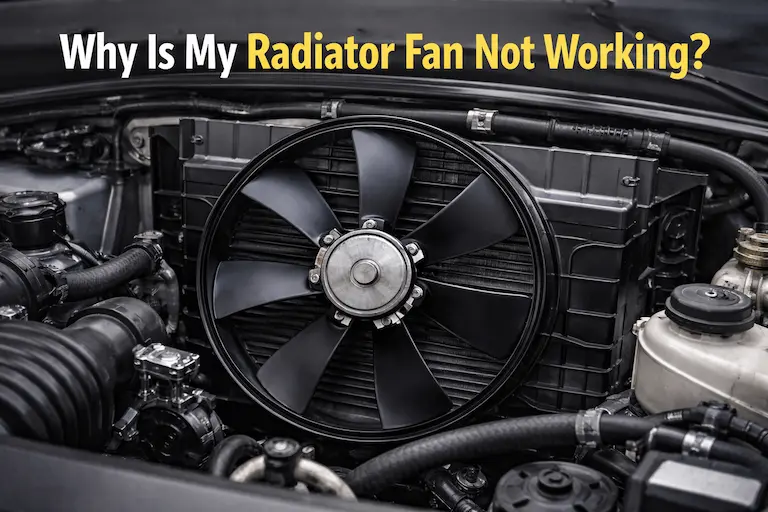
If your radiator fan has suddenly gone silent, the cause is almost always electrical. In my 18 years of turning wrenches and tracing stubborn wires, I’ve found it usually comes down to one of four things: a blown fuse, a lazy relay, a lying temperature sensor, or a tired fan motor that has simply reached the end of its life. That’s it. That’s the heart of why your radiator fan is not working.
A quick note from your mechanic: “I’m Mellahi. I’ve personally diagnosed more than 100 dead radiator fans. The biggest mistake I see? People skip the simple checks. That’s why we always begin with the fuse. That one tiny part has saved my customers thousands.”
But I know that answer alone doesn’t calm your mind. Knowing why is one thing, knowing what to do next is another. Can you still drive? Should you open the hood? How much will this cost? Those are the questions people bring to me every single day.

So in this guide, we’re going to slow things down and walk through it all together:
✔ the real symptoms,
✔ the exact causes,
✔ the step-by-step fixes you can safely try at home,
✔ when to stop and call a professional,
✔ and what each repair typically costs.
No jargon. No panic. Just clear answers from someone who’s been in the engine bay for nearly two decades.
Table of Contents
1. What Is a Radiator Fan and Why Does It Matter
Think of the radiator fan as your engine’s personal “backup wind.”
Your car cools itself in two ways:
- Natural airflow when the vehicle is moving
- Forced airflow from the electric radiator fan when the car is stopped, idling, or when temperatures rise
The fan turns on automatically when the engine temperature climbs above a safe limit or when the AC demands more airflow.
The main jobs of the radiator fan:
- Pull cool air through the radiator.
- Keep the engine temperature stable during slow driving or traffic.
- Help the AC condenser stay cool so your AC blows cold.
- Prevent overheating damage (warped head, blown gasket, cracked radiator).
Without it, the engine is basically left alone in the heat, with no backup plan.
2. Symptoms & Reasons Why Your Radiator Fan Is Not Working
Here are the exact signs people report before discovering their fan is dead:
Common symptoms:
- Temperature gauge rising quickly in traffic.
- AC blowing warm air when stopped.
- Radiator fan not spinning at all.
- Fan only runs sometimes, randomly.
- Engine overheating especially at idle.
- Burning smell under the hood.
- Coolant boiling or overflowing in the reservoir.
Why your radiator fan may not be working:
“I’ve seen customers replace $200 motors when it was a $5 fuse.”
1. Blown Radiator Fan Fuse
This is the #1 most common. A simple, cheap fix, but easily missed.
2. Faulty Radiator Fan Relay
Relays act like an on/off switch. If it sticks or burns out, the fan will never receive the signal.
3. Bad Temperature Sensor (ECT Sensor)
The engine coolant temperature sensor tells the computer when to turn on the fan. If it sends the wrong data, the fan stays off.
4. Worn-out Radiator Fan Motor
After years of heat and dust, the motor can fail completely.
5. Damaged Wiring or Loose Connectors
One loose pin is enough to stop the entire system.
6. Low Coolant or Air in the System
If coolant isn’t circulating properly, the sensor won’t detect proper heat.
7. Faulty Fan Control Module
Common in modern cars, this module controls fan speed and activation.
8. AC System Issue
Since the AC needs the fan to cool the condenser, any AC pressure sensor failure can prevent fan activation.
PRO SECRET FROM THE SHOP (Most Overlooked):
On many Ford and Chrysler models from the last decade, there’s a known wiring chafe point where the harness rubs against the frame near the battery. I’ve seen dozens of “dead fan motors” that were just a rubbed-through wire. Always trace the wires with your fingers before buying expensive parts.
3. The Fixes: From Simple Checks to Knowing When to Wave the White Flag
Take a deep breath. We start with the simplest, least expensive possibilities first. Always ensure the engine is off and cool before starting.
“Before touching anything under the hood, always wait for the engine to cool fully. Radiator components can stay dangerously hot for up to 30 minutes.”
Step 1: Check the Fuses & Relays (The 5-Minute Miracle Check)
“When I see a dead fan come into the shop, my first instinct is always the fuse box.”
Where to Start: Locate your main fuse box (under the hood) and sometimes a secondary one in the cabin. Your owner’s manual has a diagram. Look for fuses labeled “Radiator Fan,” “Cooling Fan,” “ECU,” or “ENGINE.”
What to Do: Pull the suspected fuse and hold it up to the light. Is the tiny metal strip inside broken? Replace it with one of the exact same amperage. A fuse costs under $5.

The Relay: This is the fan’s switch. Find the relay (often in the under-hood box, same diagram). Gently swap it with an identical relay next to it (like the one for the horn). Start the car and let it warm up. If the fan now works, you’ve found the culprit. A relay typically costs $15-$40.
*Pro-Tip from My 18 Years: Tap the relay lightly with the handle of a screwdriver while the car is running and warmed up. Sometimes a sticky relay will kick in, confirming the fault.*
Step 2: Listen for the Fan Motor (The Direct Power Test)
If fuses and relays are good, we need to see if the motor itself is alive.
When to Do This: Only if you’re comfortable with basic tools.
What to Do: Locate the electrical connector to the fan motor. Unplug it. Using a set of jumper wires, you can connect the fan motor directly to the car’s battery (positive to positive, negative to negative). Be careful of moving parts! If the fan spins, the motor is good, and the problem is in the car’s wiring or sensors. If it’s dead silent, the motor has failed.
When to Stop Here: If the motor is dead. Replacing it often requires removing fan shrouds and sometimes the radiator. It’s a more involved job.
Step 3: The Sensor & The Wiring (The Pro’s Territory)
If power gets to the fan but the car’s computer isn’t sending the “on” signal, the issue could be:
The Coolant Temperature Sensor (CTS): This is the messenger. If it fails, it can’t tell the ECU the engine is hot. This often requires a scan tool to diagnose.
Damaged Wiring: Look for chewed, brittle, or corroded wires in the fan circuit.
When to Call a Professional:
- If you’re not comfortable with electrical diagnostics.
- If the cooling system needs to be opened (to replace a fan attached to the radiator).
- If a scan tool is needed to diagnose sensor or ECU issues.
Cost Breakdown (Parts & Labor at a Shop):
- Fuse/Relay Fix: $20 – $80 (mostly labor for diagnosis).
- Fan Motor Replacement: $200 – $500+ depending on the car. Labor is a big factor.
- Temperature Sensor Replacement: $150 – $300.
- Wiring Repair: $100 – $250 (depends on complexity).
4. Special Case: Radiator Fan Not Working When AC Is ON
When the AC is on, the fan must run to cool the AC condenser.
If the AC is ON but the fan stays OFF, here are the usual reasons:
1. AC Pressure Sensor Failure
The system can’t “see” high pressure → fan stays off.
2. Faulty Fan Speed Control Module
Often fails under AC load.
3. Bad Low/High Fan Speed Relay
Your fan might work on “high speed” but fail on “low speed.”
4. Weak Fan Motor
AC demands more power — weak motors fail here first.
5. Clogged AC Condenser or Radiator
Heat builds up and the fan gets overwhelmed.
Fixing cost range:
- Pressure sensor: $40–$100
- Relay: $20–$60
- Fan motor: $80–$200
- Module: $90–$300
FAQs
Can I drive a car if the radiator fan is not working?
Only for a very short distance. The engine will overheat quickly, especially in traffic or at low speed. It’s risky.
How to check if a radiator fan is working?
Safely let your engine idle until it reaches normal operating temperature (mid-gauge). Observe the fan behind the radiator. It should cycle on and off. You can also turn the AC to MAX. The fan should immediately turn on in most vehicles.
Will a car overheat with no fan?
Yes, inevitably. At highway speeds, airflow may be enough to prevent it. But in city driving, idling, or on hot days, overheating is not a question of if, but when.
Can a blown fuse stop the fan from working?
Yes. This is the single most common and easiest fix. Always check the fuses first.
Is it expensive to fix a radiator fan?
It can range from dirt cheap ($5 fuse) to moderately expensive ($500+ for a difficult fan motor replacement). The key is systematic diagnosis, starting with the simple stuff.
What sensor turns on the radiator fan?
Primarily, the Engine Coolant Temperature (ECT) Sensor. The AC pressure sensor or switch can also trigger it when the AC is on.
Will the car AC work if radiator fan is not working?
It may blow cool air while you’re moving, but at a stop or in slow traffic, the AC will blow warm air because the condenser can’t release heat. You’ll also risk overheating the entire system.
Final Word of Heartfelt Advice & Your Next Move
Your car’s radiator fan is a quiet sentinel. We only notice it when it’s gone. Ignoring its silence is one of the most costly gambles you can take with your vehicle. Start with the simple checks. Feel the pride of a $5 fix. But know your limits; there’s no shame in calling a trusted professional. An overheated engine carries a heartbreak no driver should experience.
Ready to Solve This? Bookmark this page, grab your owner’s manual, and start with Step 1. You’ve got this.
Did this guide match your problem?
[ ] Yes, this is exactly what I’m seeing.
[ ] Somewhat, but I have another question.
[ ] No, my situation is different.
(This helps me create better guides for you!).
And if you hit a wall, your local electro-mechanic is there to help finish the job. Feel free to share your situation on my FB Page. I often answer questions there.