
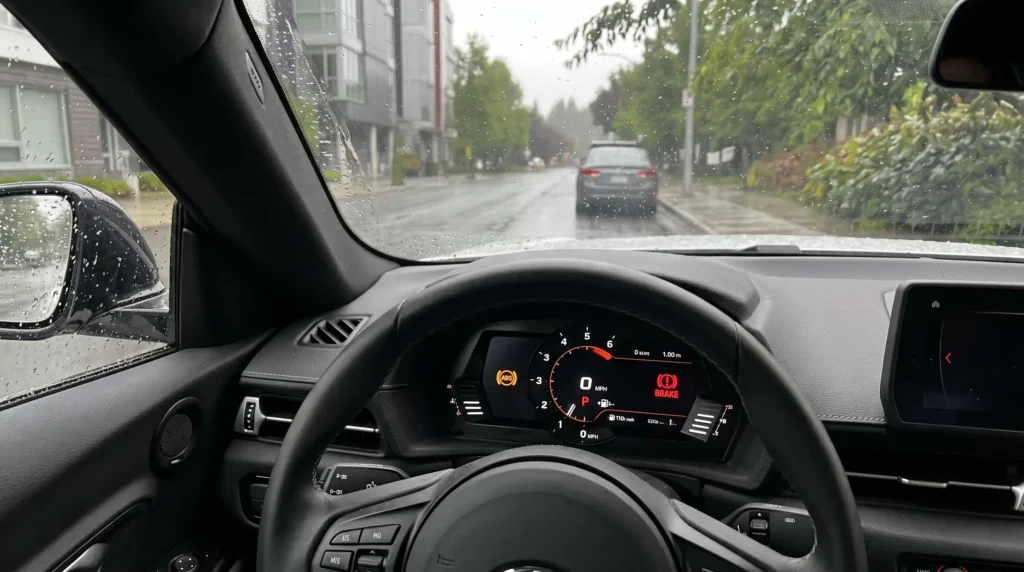
So you’re driving along, minding your own business, and then it happens. The ABS light and brake light come on together! Just staring at you from the dashboard. Yeah, I know that feeling. I’ve been there. It happened to me a few years back on a rainy morning, and I freaked out a little, not gonna lie.
So let me tell you what I wish someone had told me right then.
First, don’t panic. Second, don’t ignore it. Those two lights together can mean something as small as a dirty wheel-speed sensor or as serious as a brake-fluid leak or a failing ABS module. The honest truth is, the lights alone don’t tell you which one it is. What they do tell you is that something in your braking system needs attention, and you shouldn’t just keep driving like nothing happened.

Now, on some cars, the normal hydraulic brakes still work fine when the ABS system has a fault. But you can’t assume that just because the car still stops. If there’s also a problem with the hydraulic side of the brakes, your actual braking ability can be affected. That’s why the very first thing I want you to do is press the brake pedal.
Does it feel normal and firm? That’s a good sign, but you should still get it checked soon. Does it feel mushy, soft, unusually low, or does it sink toward the floor? Stop driving. Pull over safely. Don’t mess around with that.
In this article, I’m going to break down what these two lights actually mean, the most common causes behind them, whether it’s safe to keep driving, and how to get the problem diagnosed without getting taken for a ride. Let’s sort this out together.
Table Of Contents
Table of Contents
What It Means When the ABS Light and Brake Light Come On Together
Let me be straight with you. When I first saw those two lights, I thought my car was telling me the brakes were completely dead. That’s not necessarily the case.
The ABS light usually means the anti-lock braking system has detected a fault. Depending on what the problem is, your normal brakes may still work, but the ABS function, the thing that keeps your wheels from locking up in a panic stop, may not be there when you need it.
The brake warning light is a broader warning. It can be tied to the parking brake, low brake fluid, a hydraulic brake problem, or another brake-system fault. It depends on the vehicle.
When both lights come on together, I take that combination more seriously than an ABS light by itself. On some vehicles, that pair of lights can point to a problem with electronic brake-force distribution (EBD), which controls how braking force is split between the front and rear wheels. If EBD fails, the car may not behave the way it normally does under hard braking.
So yes, the two lights together deserve your attention. But here’s the important part. The warning lights don’t tell you exactly which component has failed. In my own experience, the right move is to check the basic brake system first and then scan the vehicle, rather than jumping straight to “the ABS module is bad.”
Now that we know what these lights are telling us, the next question is the obvious one. What actually causes them to come on together?
Common Causes of the ABS Light and Brake Light Coming On Together
When I took my car to the shop, the mechanic plugged in a diagnostic scanner and found a stored trouble code. That’s the first thing you should know. You can’t reliably diagnose this warning combo just by staring at the dashboard.

The ABS module stores specific diagnostic trouble codes that point you toward the affected circuit or component. Here are the problems worth checking.
A faulty wheel-speed sensor. This is one of the first things I’d check when the ABS light comes on. Your car uses wheel-speed sensors to monitor how fast each wheel is turning, and the ABS system relies on that data. If a sensor gets damaged, contaminated, or develops an electrical problem, the ABS system loses a reliable signal.
But don’t automatically replace the sensor just because the scan tool points at that wheel. The problem could also be the wiring, the connector, the tone ring, the wheel bearing, or another part of that signal circuit.
Low brake fluid. If the fluid level drops below the specified level, the brake warning light can come on, and depending on the vehicle, ABS-related warnings can follow. Here’s where I’d be careful: don’t just top it off and forget about it. Brake fluid can drop because of normal brake-pad wear, but it can also be a sign of a leak or another brake-system problem.
An ABS, EBD, or hydraulic brake system fault. The ABS hydraulic unit, control module, valves, and related brake circuits can all develop problems. On some vehicles, an ABS or EBD fault is what triggers both lights. This is exactly why I don’t recommend buying an expensive ABS module just because someone says, “The ABS light is on.” Get it scanned first.
Wiring, connectors, wheel bearings, or tone rings. Sometimes the electronic component itself isn’t the problem at all. A damaged wire, a corroded connector, a damaged tone ring, or a worn wheel bearing can all interfere with the wheel-speed signal. These are easy to overlook if you’re just swapping parts based on a fault code.
Electrical or voltage problems. Don’t forget the vehicle’s electrical system. A weak battery, a poor battery connection, a charging-system problem, or a bad ground can sometimes cause multiple warning lights and fault codes at the same time. That’s especially worth remembering when several lights show up at once.
Knowing the possible causes is useful, but here’s what matters more in the moment. Can you actually keep driving the car? That was the question racing through my mind when it happened to me.
Can You Drive With the ABS Light and Brake Light On at the Same Time?
Remember what the ABS system is actually there for! If it’s disabled, you may lose the system’s ability to prevent wheel lock during hard braking. That matters a lot more on wet, icy, or slippery roads. If EBD or another electronic brake-control function is also affected, the car may not behave exactly the way it normally does under hard braking.
So I wouldn’t drive around for weeks thinking, “Well, the car still stops, so it’s fine.” The warning is there for a reason.
Once you’ve decided to get it looked at, the next step is figuring out how to diagnose it without throwing money at random parts.
How to Diagnose the ABS and Brake Warning Lights
This is where I’d slow down and diagnose instead of guessing.

1. Check the brake-fluid level. Park safely and check the reservoir. The level should be within the manufacturer’s specified range. If it’s low, don’t just fill it and move on. Find out why it’s low.
2. Make sure the parking brake is fully released. On some vehicles, the brake warning light is tied to the parking-brake system. Quick check, easy to rule out.
3. Check the brake pedal. With the car safely parked, pay attention to how the pedal feels. Firm and normal? Or soft, spongy, unusually low, or sinking? A change in pedal feel is something I’d take seriously.
4. Look for signs of a brake-fluid leak. Check around the wheels and underneath the car for obvious signs of leakage. But don’t crawl under an improperly supported vehicle. If you suspect a serious leak, have it inspected safely.
5. Scan the ABS module. This is one of the most important steps. A basic OBD scanner may read engine codes but may not communicate with the ABS module on every vehicle. You want a scan tool that can access the vehicle’s ABS/ESC system and pull its diagnostic trouble codes. That code tells you which system or circuit to investigate.
6. Check the wheel-speed sensors and wiring. If the scan points toward a wheel-speed signal, inspect the sensor, the wiring, the connector, and everything around it. Look for broken or damaged wiring, corroded connectors, loose connections, dirt or contamination, damage near the sensor, and wiring rubbing against suspension components.
7. Check the wheel bearing and tone ring if needed. A damaged wheel bearing or tone ring can interfere with the wheel-speed signal. This is exactly why I don’t like replacing a wheel-speed sensor just because the scanner gave a sensor-related code. The code tells you where to look. It doesn’t always tell you what to replace.
8. Check the battery and charging system. If several warning lights appeared at once, check the battery condition, the connections, the charging voltage, and the grounds. A voltage problem can create some genuinely confusing electronic faults.
The basic path is simple. ABS and brake lights, check fluid, check parking brake, check pedal feel, scan the ABS module, inspect the suspected circuit, test the actual component. That’s a much better approach than replacing parts until the lights go away.
FAQs
Can I just ignore the lights if the car still stops?
No. The car stopping doesn’t mean everything’s fine. You might’ve lost ABS, or there could be a brake fluid leak getting worse. If the pedal feels weird, stop driving.
Will disconnecting the battery reset the lights?
Maybe for a minute. But if there’s a real problem, they’ll come right back. That’s not a fix, that’s just hiding the warning.
How much does it cost to fix?
Could be $50, could be $1,500. Depends on what’s actually wrong. That’s why you diagnose first, then talk price.
Final Thoughts
Look, seeing the ABS light and brake light on at the same time is scary. I get it. I’ve been there, staring at my dashboard on a rainy morning, wondering if my car was about to let me down.
But here’s what I’ve learned since then. Don’t panic, and don’t ignore it. Those two lights could mean something minor, or they could mean something you really don’t want to put off. You won’t know until you check.
So check your brake fluid. Pay attention to how the pedal feels. And get the ABS system scanned instead of letting someone guess and start replacing parts.
If the pedal feels soft or your braking has changed, stop driving. Don’t risk it. And if the pedal feels fine, don’t just shrug it off either. Find out what’s going on and fix it.
Because your brakes aren’t something you gamble with. Never.