
Here’s a question I get asked almost every week: “Can I get just a few more miles out of it?”
The answer usually costs someone either $1,200 or $7,000.
There’s almost no in-between.
If you’re here because your mechanic just handed you a quote that made your stomach drop, or because your odometer is getting uncomfortably close to that big number, you’re in the right place. A timing belt replacement typically runs between $850 and $2,500, depending on your vehicle, and takes about 4 to 8 hours of labor. But that’s the planned version of this story.
The unplanned version is a snapped belt, a dead engine on the side of the highway, and a repair bill that starts with a five.
I’ve spent years working under hoods, and I’ve seen the full spectrum: boring, routine maintenance that kept cars running for years, and the kind of heartbreak that comes from “I’ll wait just one more month.”
This guide isn’t a dry service manual. It’s the conversation I’d have with you if you were standing in my bay, looking at your car, and asking me what you should do.

Let’s get into it.
Table of Contents
The Short Answer You Need Right Now
There is no single timing-belt replacement interval that applies to every vehicle.
Many timing-belt applications fall somewhere around 60,000–105,000 miles, and some manufacturers also specify a maximum age. But that’s only a general reference, not a schedule you should automatically apply to your car.
Some vehicles have much longer intervals, while others have different requirements based on the exact engine, model year, market, and operating conditions. Volkswagen’s current maintenance documentation, for example, shows that timing-system inspection intervals can vary by engine and application.
So here’s the most important piece of advice in this entire article:
YOUR VEHICLE’S SPECIFIC INTERVAL IS IN YOUR OWNER’S MANUAL OR MANUFACTURER MAINTENANCE SCHEDULE.
Check it before you do anything else.
Don’t assume that because your friend’s Toyota, Honda, Ford, or Volkswagen has a certain interval, yours does too. The engine, not just the badge on the hood, is what matters.
And if you can’t find a clear interval, give the dealer or a qualified independent shop your VIN and ask them to confirm the exact maintenance requirement.

What Is a Timing Belt? The Orchestra Conductor of Your Engine
Think of your engine not as a simple machine, but as a precise, high-speed orchestra.
The pistons are the percussion section, moving up and down inside their cylinders. The intake and exhaust valves are the brass and woodwinds, opening and closing at precisely the right moments.
The timing belt is the conductor.
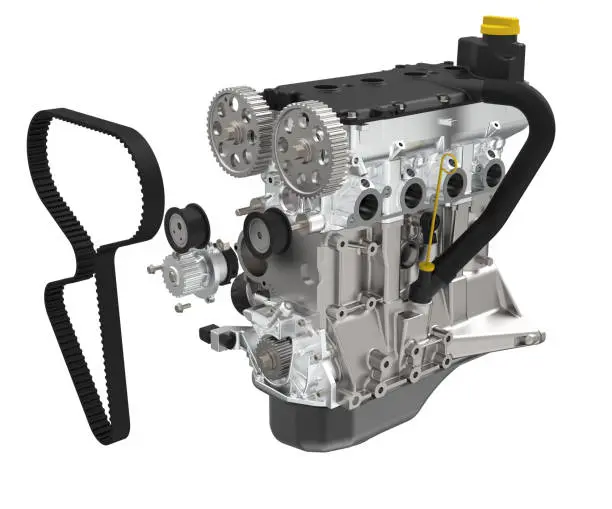
This reinforced toothed belt connects the crankshaft to the camshaft or camshafts. The crankshaft controls piston movement, while the camshafts control when the valves open and close.
The belt’s job is to keep those two sides synchronized.
And that synchronization has to remain extremely precise.
If the camshaft is even slightly out of position, the engine can run poorly. If the timing changes significantly or the belt breaks completely, the consequences can be much more serious.
What Happens When a Timing Belt Breaks?
Here’s where it gets serious.
Many engines use what’s called an interference design. In these engines, the pistons and valves can occupy overlapping physical space inside the cylinder, but they are normally kept from contacting each other because the timing system keeps them synchronized.
If the timing belt breaks or loses its timing, the crankshaft and camshaft can stop moving in synchronization.
Depending on the engine design and exactly where the failure occurs, the pistons can contact valves that are no longer in the correct position.
That can result in:
- Bent valves
- Damaged valve-train components
- Piston damage
- Cylinder-head damage
- In severe cases, much more extensive engine damage
That’s why a scheduled timing-belt replacement can look expensive until you compare it with the potential consequences of a timing failure.
On a non-interference engine, the pistons and valves are designed with enough clearance that a broken belt may not cause the same type of internal collision. But the vehicle will still stop running, and you’ll still be dealing with a tow and a repair.
The important point: don’t guess whether your engine is interference or non-interference. Verify it for your exact engine.
Timing Belt vs. Timing Chain: What’s the Difference?
Many newer vehicles use timing chains instead of belts. Here’s the basic difference.
Timing Belts
- Made from reinforced rubber and composite materials.
- Use molded teeth to synchronize the crankshaft and camshaft.
- Generally operate quietly.
- Have a manufacturer-specified replacement interval for applications that use scheduled belt replacement.
- Are affected by age, contamination, heat, and mileage.
Timing Chains
- Made from metal links.
- Run inside the engine and are lubricated by engine oil.
- Often don’t have a routine replacement interval.
- Can still wear, stretch, or develop problems with guides and tensioners.
- Are heavily dependent on proper lubrication and maintenance.
Here’s something I want you to remember:
A timing chain isn’t automatically better than a timing belt.
They’re different systems with different maintenance requirements.
A chain can last a very long time when the engine is properly maintained, but that doesn’t mean it’s impossible to fail. Worn guides, tensioners, sprockets, lubrication problems, or excessive chain wear can eventually create timing problems.
So if your car has a timing chain, don’t assume you can forget about the timing system.
And if it has a belt, don’t wait for a noise or warning light before checking the maintenance schedule.
When Should a Timing Belt Be Replaced?
This is where I want to correct one common misconception.
There isn’t a universal rule like:
“Every timing belt gets replaced at 60,000 miles.”
That’s simply not true.
The correct interval depends on the specific engine and manufacturer schedule. Gates also states that timing belts should be replaced according to the interval specified by the belt manufacturer and original-equipment vehicle manufacturer.
A Useful General Reference
For many older and newer timing-belt applications, you may see intervals somewhere around:
| General reference | What it means |
|---|---|
| 60,000–105,000 miles | A common range, but definitely not universal |
| 5–10 years | Some manufacturers specify an age limit; others use different schedules |
| Manufacturer maintenance schedule | The interval you should actually follow |
Don’t use this table to decide when your belt is due.
Use it to understand why two vehicles can have completely different schedules.
For example, current Volkswagen documentation demonstrates how manufacturer schedules can vary significantly by specific engine and application rather than simply by brand.
What If You Don’t Know When It Was Last Replaced?
This is one of the situations where I would not gamble.
If you bought a used car and there’s no service record proving the timing belt was replaced, find the maintenance requirement for your exact engine and have a qualified shop inspect the situation.
The belt might look fine from the outside and still be beyond its recommended service interval.
No documentation + unknown belt history + approaching the manufacturer’s interval = get it checked.
Red Flags: Signs Your Timing Belt Might Be Failing
Here’s the important distinction:
A timing belt should be replaced according to its maintenance schedule, not because it starts making noise.
But if something is already wrong with the belt or timing system, you might notice:
- Engine misfires or rough running.
- Hard starting or a no-start condition.
- Loss of engine performance.
- Oil contamination around the timing belt area.
- Visible cracking, fraying, or damaged teeth if the belt can actually be inspected.
- Unusual timing-related noises, depending on the engine and which component is failing.
- The vehicle is past its recommended replacement interval.
And there’s another important point:
A ticking or rattling noise does not automatically mean the timing belt is bad.
It could come from a tensioner, idler, accessory drive, valve train, timing chain, or another engine component.
That’s why replacing a belt simply because you hear a noise isn’t a diagnosis.
If you hear a new noise from the timing area, have the cause identified before buying parts.
The Replacement Process: What Actually Happens in the Shop
I want to be upfront with you:
Timing-belt replacement is not a simple “remove one belt and install another” job.
Depending on the vehicle, a technician may have to remove engine covers, accessory components, motor mounts, cooling-system components, or other parts simply to reach the timing system. RepairPal’s current repair guidance also notes that access requirements vary by vehicle.
A typical procedure can look something like this:
- Disconnect the battery and prepare the vehicle according to the manufacturer’s procedure.
- Remove the necessary covers and accessories to gain access to the timing system.
- Support the engine if required before removing an engine mount.
- Remove the crankshaft pulley or harmonic balancer when required.
- Remove the timing covers and expose the belt.
- Bring the engine to the specified timing position, commonly TDC, following the manufacturer’s procedure.
- Lock or secure the crankshaft and camshaft(s) using the correct tools where required.
- Remove the old belt and related components.
- Replace the water pump if it is timing-belt driven or otherwise specified for replacement.
- Install the new belt, tensioner, and idlers according to the manufacturer’s procedure.
- Set the belt tension correctly.
- Rotate the engine manually as specified and recheck timing alignment.
- Reassemble everything using the specified torque values and replacement hardware where required.
- Refill the cooling system if it was opened, bleed it correctly, and check for leaks.
- Start and test the engine, checking timing, coolant level, leaks, noises, and overall operation.
The exact procedure varies considerably from engine to engine, so this isn’t a job where I’d recommend improvising from a generic YouTube video.
A professional technician will use the service information for that exact engine.

How Long Does Timing Belt Replacement Take?
This is another number I wouldn’t make universal.
Some jobs can be relatively straightforward. Others require extensive disassembly and take considerably longer.
The actual labor time depends on:
- Engine layout
- Vehicle design
- Access to the timing cover
- Number of camshafts
- Water-pump design
- Engine-mount removal
- Required specialty tools
- Manufacturer procedure
- Additional components being replaced
That’s why one shop may quote several hours while another vehicle with a similar-looking engine takes significantly longer.
Don’t judge a quote only by the number of hours. Ask what’s included.
The “While You’re In There” Rule: Why the Timing System Should Be Treated as a System
As a professional, I don’t look at a timing-belt job as simply:
“Remove old belt → install new belt.”
The belt works together with the tensioner, idlers, pulleys, and, on some engines, the water pump.
That’s why the parts replaced during the job should be based on the manufacturer’s procedure, the condition of the components, and the design of the engine.
New Timing Belt
Obviously, this is the main component.
But a brand-new belt doesn’t make a worn timing system new.
Tensioner and Idler Pulleys
The tensioner controls belt tension, while idlers guide the belt along its path.
A worn bearing, damaged pulley, or weak tensioner can create problems even if the belt itself is brand new.
That’s why many timing-belt kits include the belt, tensioner, idlers, and required hardware as a complete system.
Gates, for example, offers timing-component kits that combine belts, tensioners, idlers, and supporting hardware, with vehicle-specific components included where required.
Water Pump
Here’s an important one.
If the water pump is driven by the timing belt, replacing it during the timing-belt job is commonly recommended and, for Gates’ timing-belt-driven applications, specifically recommended.
Why?
Because the pump is already accessible during the timing job.
If the pump starts leaking or its bearing fails shortly afterward, you may have to pay much of that access labor again.
But don’t assume every engine needs the water pump replaced simply because you’re doing a timing belt.
Check the manufacturer’s procedure and the condition/design of the pump.
Seals and Other Components
Depending on the engine, the technician may also inspect or replace:

- Camshaft seals
- Crankshaft seal
- Water-pump gasket
- Tensioner hardware
- One-time-use bolts
- Coolant
- Accessory belt
This is exactly why a good quote should explain what parts are actually included.
What Parts Should You Buy?
If you’re paying for the repair yourself, don’t make the mistake of choosing the cheapest timing-belt kit you can find.
This is one of those jobs where correct application and component quality matter more than saving a few dollars on the parts.
Established manufacturers such as Gates offer application-specific timing components and installation information.
You may see brands such as:
- Aisin
- Gates
- Continental / ContiTech
- INA
- Dayco
- Bando
But don’t treat this as a universal ranking.
The correct question isn’t:
“Which brand is #1?”
It’s:
“Is this the correct kit for my exact engine, and does it contain the components required by the manufacturer’s procedure?”
A reputable parts supplier or professional repair shop should be able to verify the application using the vehicle information and part number.
A Note About Buying Critical Engine Parts Online
I’d be especially careful with timing components because a wrong or counterfeit part isn’t worth the small amount of money you might save.
Instead of saying “never buy from Amazon or eBay,” here’s the advice I’d give you as a mechanic:
Buy critical timing components from a reputable supplier, established parts distributor, dealer, or trusted professional shop.
Before installing anything, verify:
- Exact part number
- Vehicle application
- Engine code where applicable
- Kit contents
- Packaging
- Manufacturer markings
- Included hardware
- Installation instructions
And if something about the part or packaging doesn’t look right, don’t install it just because you already paid for it.
Typical Timing Belt Replacement Costs in the U.S.
Now let’s talk money.
This is where a lot of timing-belt articles become misleading because they give you one giant number and pretend it applies to every vehicle.
It doesn’t.
As of August 2026, RepairPal estimates the average U.S. timing-belt replacement at approximately $889–$1,291, including estimated labor of $589–$865 and parts of $300–$426. Taxes, fees, location differences and related repairs can increase the final bill.
But look at how much the price can vary between individual vehicles:
| Vehicle | Current estimated timing-belt replacement cost |
|---|---|
| Honda Civic | $453–$686 |
| Toyota Corolla | $452–$765 |
| Toyota Camry | $626–$1,071 |
| Honda CR-V | $710–$1,026 |
| Honda Accord | $788–$1,187 |
| Volkswagen Golf | $1,025–$1,409 |
| Ford Escape | $1,251–$1,752 |
These are RepairPal estimates and can vary by location, model year, engine and the work required.
That’s why I wouldn’t tell you:
“A Toyota timing belt costs $1,000.”
I’d ask:
Which Toyota? Which year? Which engine? What’s included in the quote?
That’s the information that actually determines the price.
Why Can Two Shops Give You Very Different Quotes?
Let’s say you call two shops and one quotes $900 while another quotes $1,400.
Does that automatically mean the second shop is overcharging you?
Not necessarily.
Compare the quotes line by line.
One may include:
- Timing belt
- Tensioner
- Idlers
- Water pump
- Coolant
- Seals
- New hardware
- More expensive OE-equivalent parts
- Longer warranty
The cheaper quote may include only the belt and basic labor.
That’s why the cheapest quote isn’t always the cheapest repair.
Ask the shop to explain exactly what you’re paying for.
Questions to Ask Your Mechanic
You don’t need to become a technician overnight.
Just ask these questions before approving the job:
1. “What is the exact timing-belt interval for my engine?”
This prevents you from relying on a generic mileage number.
2. “Is my engine interference or non-interference?”
If it’s an interference engine, you’ll understand why keeping the timing system maintained matters so much.
3. “Is the water pump driven by the timing belt?”
If yes, ask whether the manufacturer or repair procedure recommends replacing it at the same time.
4. “What’s included in your quote?”
Ask specifically about:
- Belt
- Tensioner
- Idler pulleys
- Water pump
- Seals
- Coolant
- Hardware
5. “What brand of parts are you installing?”
You don’t necessarily need the most expensive parts, but you should know what you’re buying.
6. “Are any one-time-use bolts or special hardware required?”
Some engines require replacement hardware during reassembly. Your technician should follow the manufacturer’s torque and hardware requirements.
7. “What warranty do you provide on parts and labor?”
A professional repair should come with clear warranty terms.
What If You’re Thinking About Doing It Yourself?
I understand the temptation.
You’ve watched a few videos, you’ve got a decent tool collection, and suddenly that $1,200 estimate starts looking like a weekend project.
But here’s where I’d slow down.
Timing-belt replacement isn’t difficult because the belt itself is complicated. It’s difficult because everything has to be positioned, tensioned, and torqued correctly.
One mistake can leave you with:
- Incorrect valve timing
- A no-start condition
- Engine damage
- Coolant leaks
- Oil leaks
- A belt that jumps timing
You’ll also need to follow the exact procedure for your engine, including any required locking tools, torque specifications and tension-setting procedure.
If you’re an experienced DIY mechanic with the correct service information and tools, that’s one thing.
If you’ve never done a timing job before, this is not where I’d recommend learning by trial and error.
Frequently Asked Questions
Can you still drive with a bad timing belt?
No. A failing belt can snap at any moment. If that happens at highway speed, the engine will stop instantly, and in interference engines, the valves and pistons will collide. Tow it. Don’t risk it.
How do I check my timing belt?
Some vehicles have inspection covers; you can peek at the belt to check for cracks or fraying. But in many cars, the belt is buried behind covers. That’s why I recommend having it inspected at regular service intervals.
What are the symptoms of a bad timing belt?
- Engine misfires or rough running
- Car won’t start or struggles to start
- Clicking or ticking noises from the engine
- Oil leaks near the timing cover
- Visible belt wear (if you can see it)
Why is replacing a timing belt so expensive?
It’s not the belt; it’s the hours of labor. Mechanics must disassemble engine covers, sometimes remove motor mounts, align everything with precision, and torque it all back to spec. It’s like surgery: slow and exacting.
Is a timing belt covered under warranty?
It depends on the vehicle’s age, mileage, and any manufacturer recalls or extended warranties. Timing belts are considered wear items on most cars. Check with your dealer before paying; sometimes there are service campaigns you might not know about.
Final Thoughts
If there’s one thing I’ve learned after all these years under the hood, it’s this: timing belts don’t care about excuses.
I’ve watched careful owners drive their cars past 200,000 miles because they stayed on top of this service. I’ve also seen good engines destroyed because someone thought, “I’ll wait until next month.”
This little belt may not look like much, but it’s the heartbeat of your engine. Change it when the book says to; do the full kit, and you’ll never regret the money spent. Ignore it, and you could be shopping for a new engine instead of enjoying your next road trip.
Quick Action Steps:
- Right now: Check your owner’s manual for your car’s specific interval.
- If you’re due or don’t know: Call a trusted independent shop and get a quote.
- When you get the quote: Ask about the water pump, tensioner, idlers, and parts brand.
- Schedule it: Don’t delay. A planned $1,200 service beats a $7,000 surprise every time.
Disclaimer: Every car has its own rules. What I’ve shared here comes from years in the shop and countless timing belt jobs, but your owner’s manual should always have the final say. If you’re unsure, ask a mechanic you trust before you make the call.
Pingback: Proven Gearbox Oil Change Advice: Cost, Symptoms & Guide
Pingback: EPC Light on Car: What It Means & Pro Fixes (2025 Guide)
Pingback: Honda Accord 2015 to 2025: Complete Expert Buying Guide