
That odd clunk you hear when you hit the brakes. The dashboard light that flickers on, then off. The sinking feeling when you turn the key and hear… nothing. If you’re reading this, you know the stress. You’re not just driving a car; you’re managing a rolling bundle of “what-ifs.”
Let me tell you a secret from 18 years in the shop as an electromechanic: that stress is almost entirely optional.
The truth is simple but powerful: catastrophic repairs don’t just happen. They are invited by ignored maintenance. The difference between a reliable car and a money pit isn’t luck—it’s a system. A checklist.
This is that system. My Car Maintenance Checklist is the non-negotiable routine that replaces worry with certainty. It’s built on nine pillars you must respect:
- Oil & Filter Changes: Your engine’s lifeblood.
- Fluid Levels: Coolant, brake, transmission, power steering.
- Brake Condition: Pads, rotors, fluid.
- Battery Health: Terminals and charge.
- Tire Wear & Pressure: Your only contact with the road.
- Belts & Hoses: The rubber that holds your car together.
- Lights & Safety Checks: Being seen is survival.
- Air & Cabin Filters: For engine power and clean air.
- Mileage-Based Essentials: The master timeline.
If you follow this map, you buy more than peace of mind. You buy freedom. Freedom from roadside surprises. Freedom from shocking repair bills. Freedom to know your car is safe for everyone you love.
Keep reading. I’ll walk you through every single step. This isn’t just a list; it’s your car’s lifeline.
Table of Contents
Your Car Maintenance Checklist by Mileage: Stop Guessing, Start Following
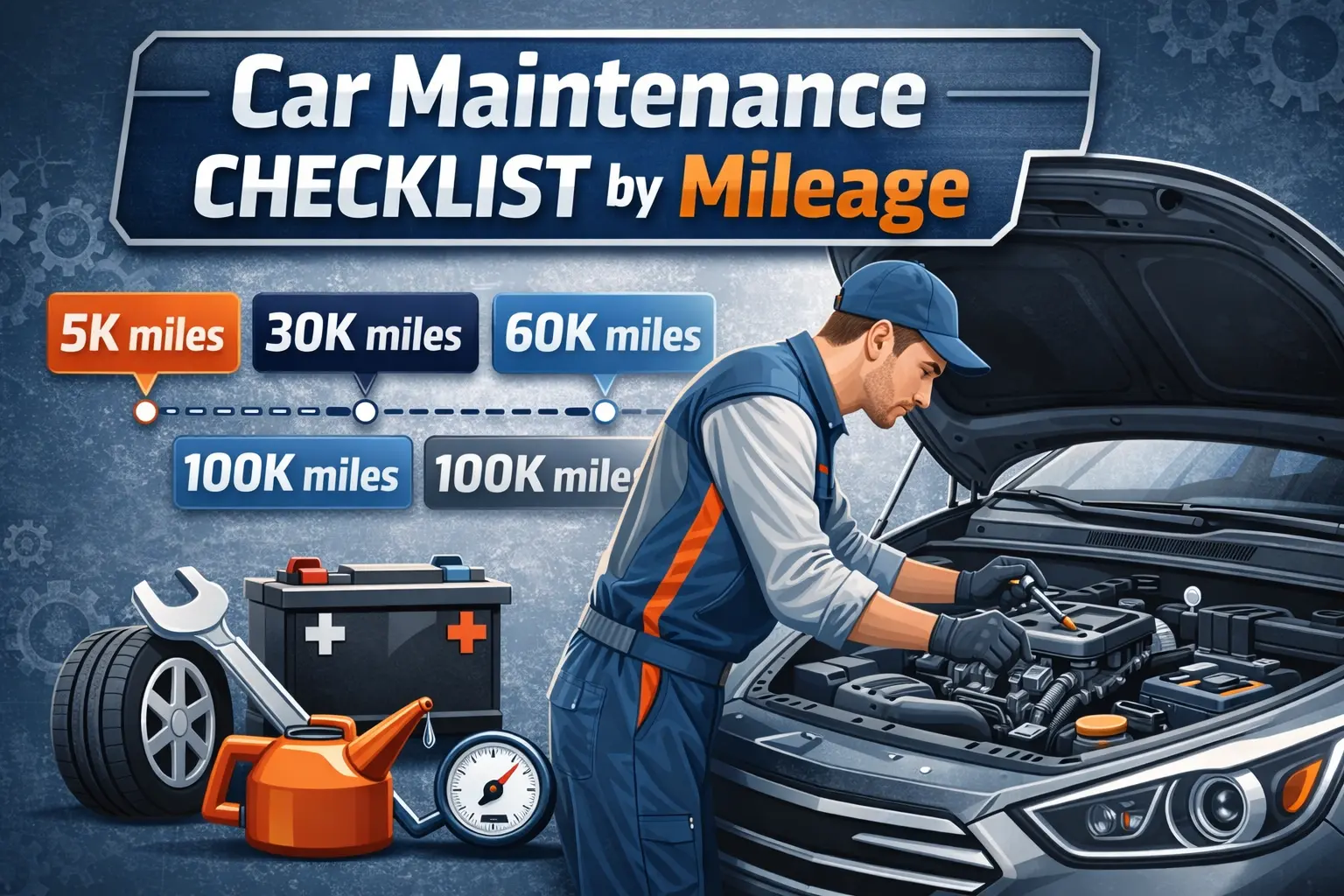
Forget random dates. Your car speaks in miles. This car maintenance checklist by mileage translates its language into clear action. Stick to this, and you’ll never be blindsided.
The 5,000–7,000 Mile (8,000–11,000 km) Service: The Foundation
This is non-negotiable hygiene. Skip it, and everything else gets more expensive.
- Oil & Filter Change: This isn’t a suggestion. Old oil turns to sludge, grinding your engine from the inside out. I’ve rebuilt engines where the only cause was “I missed a few oil changes.” Don’t be that person.
- The Quick Scan: While you’re under the hood, make it a habit: Check tire pressure (including the spare), inspect the engine air filter, and look at the brake fluid level in its clear reservoir. Rotate your tires. This one act extends their life by thousands of miles.
The 30,000 Mile (48,000 km) Service: The First Major Checkpoint
Now we’re looking deeper. Components have started to wear.
- Cabin Air Filter Replacement: Your nose will thank you. A clogged filter blows dust and pollen into the cabin and strains your A/C system.
- Fuel System Check: A bottle of quality fuel injector cleaner here can keep things running smoothly and maintain good gas mileage.
- Transmission Fluid Inspection: Pull the dipstick (if you have one). Is the fluid bright red and sweet-smelling, or dark brown and burnt? Its condition tells you everything. Low or degraded fluid is a top cause of transmission failure.

60,000 Mile Car Maintenance Checklist (Mid-Life Tune-Up)
Critical wear items need attention. This service prevents a cascade of problems.
- Spark Plug Replacement: Worn plugs cause rough idles, poor acceleration, and wasted fuel. Fresh plugs restore that smooth, efficient power: you may need to read this article(Spark Plug Replacement Cost: The Full Story (No Surprises!)
- Drive Belt Inspection: Open the hood and look at the serpentine belt. Check for cracks, glazing, or fraying. If it snaps, your alternator, power steering, and A/C die instantly.
- Brake Fluid Flush: This is often overlooked. Brake fluid absorbs moisture over time, which leads to corrosion inside the brake lines and a dangerously soft pedal. A flush is cheap insurance for your most important safety system.
The 90,000–100,000 Mile (145,000+ km) Service: The Longevity Milestone
You’ve cared for your car well. Now, protect your investment from major failure.
- Timing Belt/Chain Inspection: This is the big one. If your car has a rubber timing belt, replacing it at the manufacturer’s interval (often here) is critical. If it breaks, the engine can self-destruct. A timing chain lasts longer but should be checked for stretching or guide wear, often signaled by a rattling noise on startup.
- Coolant Flush: Coolant loses its anti-corrosive and lubricating properties. Fresh coolant prevents rust in the radiator and heater core, and protects your water pump.
Your Saturday Morning Ritual: Become Your Car’s Best Friend (In 10 Minutes Flat)
Between the big mileage services, there’s the simple stuff. The human stuff. This isn’t about being a mechanic—it’s about having a relationship with the machine that gets you to work and brings your family home safe.
Let’s make this a habit. Next time you’re filling up with gas or just getting home on a Saturday morning, give me ten minutes. Here’s what we’ll do together:
The Fluid Check (The Lifeblood Scan):
- Pop the hood. Let’s check the engine oil. Pull the dipstick (it’s usually bright yellow), wipe it clean with that old rag you keep in the trunk, slide it all the way back in, then pull it out again. See where the oil film hits? Between the two dots or holes is perfect. Is the oil black and thin like coffee? It’s talking to you—it’s tired.
- Find the coolant reservoir (the plastic tank with the colored liquid). Important: Only do this when the engine is stone cold, like first thing in the morning. The level should be between the “MIN” and “MAX” lines. If it’s low, top it up with the correct type (check your manual!).
- Peek at the brake fluid and power steering fluid reservoirs. Just a visual. Are they near the “Full” line? Is the brake fluid the color of maple syrup or dark coffee? Note it.
The Tire & Safety Walk-Around (The Connection Check):
- Grab your tire pressure gauge. Check all four tires. The correct PSI is on the sticker inside your driver’s door jamb—not on the tire itself. Under-inflated tires wear out fast and waste gas. It takes 30 seconds per tire.
- Do the “Penny Test.” Take a penny and stick it into your tire’s tread groove with Lincoln’s head pointing down. If you can see all of his head, your tires are legally bald and dangerously slick in the rain. Time for new shoes.
- Turn on your car. Walk around it. Check your headlights (low and high beams), brake lights (press the pedal or put a rock on it), turn signals, and hazard lights. A dead bulb is a ticket waiting to happen and makes you invisible. Now look at your wiper blades. Do they smear more than they clear? That’s a safety hazard you can fix for $20.
That’s it. Ten minutes. You’ve just connected with your car, learned its language, and probably caught a small problem before it became a big, expensive one. You’re no longer just a driver—you’re a partner.
Car Care Questions You’re Too Busy to Ask
What types of Car maintenance exist?
In my shop, I see two kinds: the maintenance you choose (oil changes) and the maintenance that chooses you (a tow truck). Aim for the first kind.
What 5 things should I know how to fix myself?
- Check and add oil
- Fill tires properly
- Jump-start safely
- Change a flat
- Swap wiper blades
What are the different levels of car work?
Your level (checking things), shop level (oil changes), and expert level (engine repairs). Stay in the first two zones as long as you can.
How can I tell if my car needs attention?
It talks to you. New squeaks? Pulling to one side? Weird smells? Dashboard lights? That’s your car asking for help before it breaks down.
What happens if I just ignore maintenance?
You’ll pay ten times more later. That $80 brake check becomes $800 in ruined rotors. That delayed oil change becomes a dead engine.
Is it worth learning to fix my own car?
Start small. Changing your air filter takes 5 minutes and saves $40. Doing your own oil change saves $60. Some jobs need a mechanic, but the easy wins build confidence and save real money.
A Final Word From the Shop
Look, I’ve handed thousands of estimates to shocked customers. The hardest part of my job isn’t fixing cars—it’s telling someone a $3,000 repair could have been a $300 service.
This checklist is your shield against that conversation. It turns the complex machine in your driveway into a predictable partner. You don’t need to love cars. You just need to respect the simple system that keeps them running.
Print this car maintenance checklist. Stick it in your glove box. Use it. The savings, the safety, the sheer lack of drama—it’s all real.
Now, I’d love to hear from you. Drop a comment below and tell me: What’s the one car noise or quirk that’s been bothering you lately? Or, what’s the last maintenance task you crossed off your list? Your experience might just help another driver sleep easier tonight.
Let’s talk.