
If your car loses power while driving, it can be pretty unsettling, especially when you’re in traffic or trying to get up a hill.
And honestly, there isn’t always one obvious cause. It might be something small, like worn spark plugs, a dirty air filter, or a fuel problem. It could also be something more serious, such as a clogged catalytic converter, a turbo problem, or a transmission issue.
Before you start buying parts, stop and look at the symptoms. Does the RPM drop? Is the engine shaking? Does the RPM climb while the car barely moves?
Those little details can tell you a lot, and they can keep you from spending money on parts you don’t actually need.
Let’s look at the most common causes, what you can check first, and when it’s better to stop driving and have the car looked at.
Table of Contents
What does “losing power” actually mean?
Power loss doesn’t always mean the engine is about to fail.
You might notice that:
- The car is slow to accelerate.
- Pressing the gas pedal produces little response.
- The engine struggles going uphill.
- The vehicle hesitates or jerks.
- The engine runs roughly.
- The RPM suddenly drops.
- The engine RPM rises, but the car barely gains speed.
- The vehicle won’t go beyond a certain speed.
- Power disappears and returns after a few seconds or after restarting.
These symptoms may look similar from the driver’s seat, but they don’t all point to the same problem.
That’s why the first question should be:
What exactly happens to the engine RPM when the power disappears?
If the RPM falls while the engine struggles, start thinking about the engine itself: fuel, air, ignition, exhaust, sensors, or mechanical problems.
If the RPM shoots up but the vehicle doesn’t accelerate normally, the transmission or clutch becomes much more suspicious.
9 common reasons a car loses power while driving
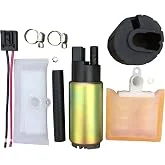
1. Weak fuel pump or restricted fuel delivery
Your engine needs a steady supply of fuel, especially when you accelerate or climb a hill.
A fuel pump can sometimes keep the engine running at light load but fail to maintain adequate fuel delivery when demand increases. A restricted fuel filter, fuel-pressure problem, contaminated fuel, injector problem, or electrical problem affecting the pump can create similar symptoms.
You may notice:
- Power loss during hard acceleration.
- Hesitation at higher speeds.
- Worse performance going uphill.
- Engine sputtering.
- Difficulty starting in some cases.
- An engine that loses power after driving for a while.
A fuel-pressure test is much more useful than simply replacing the fuel pump based on symptoms.
Low fuel pressure under acceleration can produce a lean condition, misfire, hesitation, and loss of power.
Diagnostic clue: If the car runs reasonably well at light throttle but loses power when you demand more from it, fuel delivery deserves attention.
2. A clogged air filter or airflow problem
An engine needs a continuous supply of air to make power. A heavily restricted air filter can reduce airflow, while problems with the intake system or airflow sensors can cause the engine computer to receive incorrect information.
A dirty or failing MAF sensor can be especially confusing because the engine may still start and idle normally while behaving poorly under acceleration.
Possible symptoms include:
- Sluggish acceleration.
- Hesitation.
- Poor fuel economy.
- Rough running.
- Check Engine Light.
- Loss of power under load.
Don’t replace the MAF sensor just because a scan tool produces an airflow-related code. The sensor, wiring, intake system, and air filter all need to be considered.
3. Bad spark plugs or ignition coils
On gasoline engines, the ignition system has to produce a strong spark at the right time.
A worn spark plug or failing ignition coil can cause a misfire, which means one or more cylinders are not producing normal combustion.
The problem may be much easier to notice when accelerating because the engine is under greater load.
Look for:
- Shaking or rough running.
- Hesitation.
- Sudden loss of power.
- Poor acceleration.
- Flashing Check Engine Light.
- Difficulty climbing hills.
A flashing Check Engine Light should not be ignored. A severe active misfire can damage the catalytic converter.
If a scan shows a cylinder-specific misfire code, diagnose that cylinder rather than immediately replacing several unrelated parts.
4. A clogged catalytic converter or restricted exhaust
The engine has to get rid of exhaust gases as efficiently as it takes in air.
If the exhaust system becomes severely restricted, the engine can struggle to breathe out, particularly when you demand more power.
This can produce a very specific pattern:

The car may feel acceptable at low speed but become extremely weak as RPM and engine load increase.
You might also notice:
- Poor acceleration
- Reduced top speed
- Poor fuel economy
- Excessive heat around the exhaust
- An unusual exhaust smell
- Check Engine Light
A P0420 or similar catalyst-related code does not automatically prove that the catalytic converter is physically clogged. Catalyst efficiency and exhaust restriction are related but different diagnostic questions.
A backpressure or other appropriate exhaust-flow test can help confirm an actual restriction.
5. A faulty throttle body or throttle-position system
Modern vehicles use electronic throttle control in many applications.
If the throttle body, accelerator-pedal sensor, throttle-position sensors, wiring or related control system develops a problem, the engine computer may limit throttle response.
The result can feel like:
“I’m pressing the accelerator, but the car isn’t listening.”
Some vehicles may also enter a reduced-power or limp-home mode.
Depending on the vehicle, you may see a warning message, Check Engine Light or traction/electronic throttle warning.
Because throttle-control systems are safety-related, follow the manufacturer’s diagnostic procedure rather than guessing which sensor needs replacement.
6. Turbocharger or boost problem
If your vehicle has a turbocharged engine, boost problems move higher on the list.

Turbocharger with Gasket Compatible with Honda Civic 2006-2015, for BMW
A split boost hose, loose connection, faulty boost-control component, sensor problem, or turbocharger fault can prevent the engine from producing normal power.
Common clues include:
- Power loss mainly during acceleration.
- Weak performance under load.
- A whooshing sound.
- Reduced boost.
- Check Engine Light.
- Vehicle entering reduced-power mode.
A turbo engine that suddenly feels naturally aspirated isn’t necessarily suffering from a failed turbocharger. Check the intake and boost-control system before condemning the turbo itself.
7. The transmission or clutch may be slipping
Not every “loss of power” comes from the engine.
Here’s one of the most useful clues:
If engine RPM rises sharply but vehicle speed doesn’t increase accordingly, suspect the drivetrain rather than the engine.
On a manual transmission, a worn clutch can slip.
On an automatic transmission, problems with the transmission, fluid, clutch packs, torque converter or electronic controls can produce similar symptoms.
You may notice:
- RPM suddenly increasing.
- Poor acceleration despite high RPM.
- Delayed gear changes.
- Harsh shifting.
- Transmission warning messages.
- A burning smell in some cases.
This is why watching the tachometer during the event is so valuable.
8. The car has entered limp mode
Sometimes the car isn’t simply “weak.” It is deliberately limiting its performance.
Modern vehicles monitor the engine, transmission, throttle, turbocharger and emissions systems. When a significant fault is detected, the control system may reduce engine power or limit available gears to protect the vehicle.
You may notice:
- Very poor acceleration.
- A maximum-speed limitation.
- Limited RPM.
- Transmission stuck in one gear.
- Warning lights or messages.
- Power returning temporarily after switching the vehicle off and restarting.
Restarting may temporarily clear the symptom, but it doesn’t necessarily fix the underlying fault.
If the problem keeps returning, scan the vehicle for diagnostic trouble codes and diagnose the cause instead of repeatedly resetting the system.
9. Overheating or another serious mechanical problem
If the engine temperature is climbing while power is dropping, don’t keep driving just to see whether the problem goes away.
Overheating can cause the engine computer to reduce performance, and continued driving with an overheating engine can cause serious damage.
Other serious warning signs include:
- Oil-pressure warning.
- Smoke.
- Unusual engine noises.
- Strong burning smells.
- Severe vibration.
- Sudden loss of braking or steering assistance.
In these situations, the priority is no longer diagnosing the problem on the roadside. Get the vehicle somewhere safe and arrange professional assistance.
What should you do if your car suddenly loses power while driving?
Safety comes first.
If you notice significant power loss:
- Stay calm and keep control of the vehicle.
- Ease off the accelerator.
- Turn on your hazard lights if appropriate.
- Move toward a safe location when you can do so safely.
- Stop if the vehicle becomes unsafe to operate.
- Check the dashboard for warning lights or messages.
- Do not continue driving if there is overheating, smoke, severe engine noise, a flashing warning light, or a serious loss of braking or steering assistance.
A vehicle that loses power completely can behave differently from one that simply has poor acceleration. If the engine stalls, steering and braking assistance may change depending on the vehicle, so getting safely out of moving traffic should be the priority.
Safety recalls can also cause loss of motive power in some vehicles. NHTSA recommends checking your VIN for open recalls, particularly when a vehicle has an unexplained safety-related problem.
How to diagnose a car that loses power while driving
Don’t start by buying parts.
Start with the symptom.
Step 1: Find out whether the engine is still running
If the engine is running but the vehicle won’t accelerate, you’re dealing with power delivery.
If the engine actually shuts off, you need to investigate stalling.
Those are two different diagnostic paths.
Step 2: Watch the RPM
This is one of the quickest clues.
RPM drops:
Look toward fuel, ignition, airflow, exhaust, sensors or engine problems.
RPM rises but speed doesn’t:
Look toward the clutch or transmission.
RPM becomes limited:
Consider reduced-power or limp mode.
Step 3: Check the warning lights
Write down exactly what appears.
Don’t rely on memory later.
For example, a battery warning light combined with dimming electrical accessories points toward the charging system rather than a simple fuel or ignition problem.
The alternator supplies electrical power while the engine is running and recharges the battery. A charging-system failure can eventually cause the engine and electrical systems to shut down.
Step 4: Scan for OBD-II codes
If you have an OBD-II scanner, scan the vehicle before clearing anything.
Codes can provide useful direction, such as:
- P0300–P030x: misfire-related faults.
- P0171/P0174: lean-condition faults.
- P0101: MAF range/performance.
- P0299: turbo underboost.
- P0420/P0430: catalyst-efficiency faults.
A trouble code is a clue, not automatically a failed part.
For example, a lean code doesn’t necessarily mean the oxygen sensor is bad. The actual cause could be a vacuum leak, fuel-pressure problem, restricted fuel delivery or another issue.
Step 5: Test before replacing parts
Depending on the symptoms, a proper diagnosis may include:
- Fuel-pressure testing
- Intake and vacuum inspection
- MAF and throttle data
- Ignition and misfire testing
- Boost-pressure testing on turbo engines
- Exhaust restriction testing
- Charging-system testing
- Transmission diagnosis
- Compression or other mechanical testing when necessary
This approach is slower than throwing parts at the problem, but it is usually much cheaper.
Can you keep driving when your car is losing power?
It depends on how severe the problem is.
A minor hesitation that occurs occasionally still deserves diagnosis, but severe or sudden power loss is a safety concern, particularly in traffic or at highway speed.
Stop driving and arrange an inspection if:
- The engine stalls.
- The Check Engine Light is flashing.
- The temperature warning indicates overheating.
- The oil-pressure warning comes on.
- You see smoke.
- You smell fuel or burning material.
- The engine makes severe or unusual noises.
- Braking or steering assistance changes.
- The vehicle repeatedly enters reduced-power mode.
Don’t treat a recurring power-loss problem as normal just because the vehicle starts working again after a restart.
FAQs
Why does my car lose power when accelerating?
Usually, the engine is struggling under load. Fuel delivery, spark plugs, ignition coils, airflow, turbo boost, or a restricted exhaust are common causes.
Can a bad battery cause a car to lose power while driving?
Not usually. The alternator powers the car while the engine is running. If the charging system fails, the car can eventually lose electrical power and stall.
Can bad spark plugs cause loss of power?
Yes. Worn or faulty spark plugs can cause misfires, leading to hesitation, rough running, and reduced power.
Can a clogged catalytic converter cause power loss?
Yes. A severely clogged catalytic converter can restrict exhaust flow and make the engine lose power, especially under acceleration.
Why does my car lose power and then work normally again?
An intermittent fuel, ignition, sensor, throttle, turbo, or electrical problem can cause temporary power loss. If a restart fixes it, the problem may still be there.
Final thought
When a car loses power while driving, the biggest mistake is guessing at the part.
The symptom alone doesn’t tell you whether you need a fuel pump, spark plugs, MAF sensor, catalytic converter, turbocharger or transmission repair.
Start with the pattern. Watch the RPM. Check the warning lights. Scan for codes. Then test the system that best matches the symptoms.
That simple approach can save you from replacing good parts while the real problem remains untouched.