
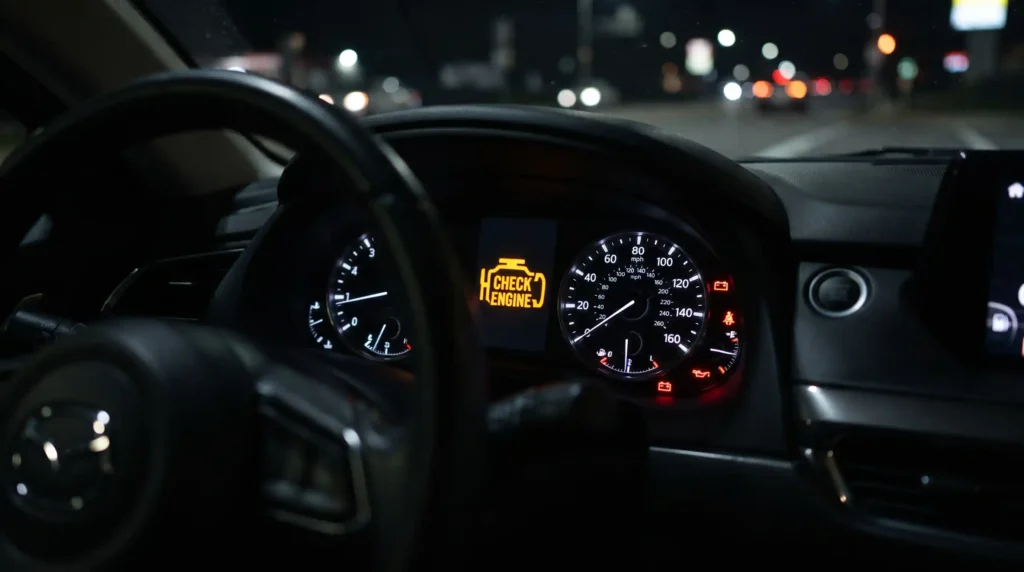
That little amber glow just appeared on your dash, right? Your stomach drops, and suddenly you’re bracing for a massive repair bill. But here’s the truth you need right now: a check engine light on does NOT mean your engine is dying.
Look at the light. Is it solid or flashing?
- Solid: Something’s off; get it checked soon, but you’re okay to drive.
- Flashing: This is urgent. It usually means an engine misfire that can destroy your catalytic converter ($1,500+) in minutes. Pull over safely.
The fastest way to stop guessing is to pull the diagnostic code with an OBD2 scanner. But here’s the golden rule: that code is a clue, not a shopping list. Don’t replace parts just because the code mentions them; diagnose the root cause first.
Let me walk you through exactly what to do, step by step.
Table of Contents
First Things First: Look at the Light
Before you do anything else, look closely at your dashboard. Is the check engine light solid or flashing? This one detail changes everything.
The golden rule: Solid = schedule a diagnosis. Flashing = get off the road now.
What Is This Light Actually Telling You?
The check engine light, officially called the Malfunction Indicator Lamp (MIL), is connected to your car’s OBD-II system (On-Board Diagnostics). This system has been standard on all cars sold in the U.S. since 1996.
Here’s what most people get wrong: the light itself is not a diagnosis. It doesn’t tell you exactly what’s broken. It tells you that something needs attention. The actual problem could be as minor as a loose gas cap or as serious as a failing catalytic converter.
The only way to know is to read the diagnostic trouble code (DTC) stored in your car’s computer. That code points you toward the system that triggered the light, but it doesn’t always tell you which part to replace.
The Most Common Causes (Ranked by How Often They Happen)
Based on data from over 39 million vehicles analyzed by the CarMD Vehicle Health Index, here are the most frequent check engine light triggers and what they’ll cost you:
The average cost to address a check engine light hit a record $554 in 2025, a 33% increase from the previous year, driven by rising parts and labor costs.
Let’s Walk Through Each Cause
1. Loose or Faulty Gas Cap (Most Common!)

If your light came on right after filling up, start here.
The gas cap is part of your car’s EVAP (evaporative emissions) system, which keeps fuel vapors from escaping into the air. If the cap isn’t sealed properly, the system detects a leak and turns on the light.
What to do:
- Turn off the engine.
- Remove the gas cap and inspect the rubber seal for cracks or damage.
- Put it back on and tighten it until you hear at least one click.
- The light may take a few drive cycles to turn off on its own, or you can clear it with an OBD2 scanner after confirming the fix.
If the light stays on after a week of normal driving, the cap itself may need replacing (around $28).
2. Oxygen (O₂) Sensor Failure
Oxygen sensors monitor your exhaust and help your engine computer adjust the air-fuel mixture for optimal performance and emissions.
Symptoms: Poor fuel economy, rough idle, failed emissions test.
⚠️ Critical warning: An O2 sensor code does NOT automatically mean the sensor is bad. The sensor might be correctly reporting a problem caused by something else, like a vacuum leak, exhaust leak, or fuel mixture issue.
What to do: Diagnose the system, not just the sensor. Test for other causes before replacing it. If it truly is the sensor, expect to pay around $287 on average.
3. Catalytic Converter Problem
The catalytic converter reduces harmful exhaust emissions. It’s expensive to replace $1,511 on average, which is why you want to be absolutely sure before replacing it.
Symptoms: Reduced power, sulfur smell (like rotten eggs), rattling noise.
Critical point: A catalytic converter usually fails because something else caused it to fail, like an ignored misfire, a bad O2 sensor, or worn spark plugs.
What to do: Don’t replace the converter just because you see a P0420 code. Find and fix the root cause first, or you’ll destroy the new converter too.
4. Spark Plugs or Ignition Coils
Worn spark plugs or failing coils cause engine misfires, one of the most common reasons for a flashing check engine light.
Symptoms: Engine shaking, rough idle, hesitation during acceleration, loss of power.
What to do: Scan for codes like P0300 (random misfire) or P0301–P0308 (specific cylinder misfire). A mechanic can test by swapping coils between cylinders; if the misfire follows the coil, you’ve found the problem.
Average cost for coils and plugs: ~$480.
5. Mass Airflow (MAF) Sensor

The MAF sensor measures how much air is entering the engine so the computer can calculate the right amount of fuel.
Symptoms: Rough idle, stalling, poor acceleration.
What to do: Sometimes a dirty MAF sensor can be cleaned with MAF cleaner spray. If replacement is needed, average cost is ~$346.
6. EVAP System Leak (Not Just the Gas Cap)
The EVAP system includes hoses, valves, and the charcoal canister, not just the gas cap.
Symptoms: Light comes on intermittently, possible fuel smell.
What to do: A smoke test can help locate the leak. Common culprits include the purge valve or vent valve.
Symptom-Based Guide: “My Check Engine Light Is On AND…”
❓ “…my car is shaking.”
Likely cause: Engine misfire (bad spark plugs, ignition coils, or fuel injectors).
What to do:
- If the light is flashing: Pull over immediately. You’re actively damaging the catalytic converter.
- If the light is solid: Get it diagnosed soon. Scan for codes P0300–P0308.
❓ “…after I got gas.”
This is usually the easiest one to fix.
Step 1: Check the gas cap. Tighten it properly.
Step 2: If the light stays on, scan for codes. You’re likely dealing with an EVAP-related code (P0440, P0441, P0442).
Step 3: If the cap was fine, the purge valve or another EVAP component may be faulty. Average cost: ~$172.
❓ “…after an oil change.”
Don’t panic, this happens more often than you’d think.
Common causes:
- Oil filler cap left loose or off: this creates a vacuum leak and triggers the light.
- Oil dipstick not fully seated: same issue, allows unmetered air into the engine.
- Incorrect oil viscosity: modern engines are sensitive to the right oil grade.
- Oil overfilled or underfilled: both can cause pressure issues.
- Sensor or hose accidentally bumped during service.
What to do:
- Check the oil level on the dipstick.
- Make sure the oil filler cap is tight.
- Make sure the dipstick is fully seated.
- If everything looks right, scan for codes.
❓ “…but the car runs fine.”
This is very common.
A car can feel completely normal even though the computer has detected an emissions or monitoring fault. EVAP problems, in particular, often cause no noticeable drivability issues.
What to do: Don’t ignore it. Get it scanned and find out what’s going on. A small problem today can become an expensive one tomorrow.
❓ “…but my scanner shows no codes.”

This is frustrating and surprisingly common.
Possible reasons:
- Your OBD2 scanner isn’t compatible with your vehicle or can’t read all modules.
- The code is pending (meaning the issue hasn’t happened enough times to store a confirmed code).
- The fault is intermittent and cleared itself before you scanned.
- Your scanner only reads generic codes, not manufacturer-specific ones.
What to do:
- Try a more advanced scanner or take it to a shop with professional-grade equipment.
- Check simple things: gas cap, battery health (low voltage can cause weird issues).
- If the light is on, there is a code; your tool just can’t see it.
Should You Clear the Code Yourself?
You can clear codes with an OBD2 scanner. But don’t do it before diagnosing the problem.
Why:
- Clearing the code erases useful diagnostic information (including “freeze frame” data that shows what was happening when the fault occurred).
- It resets emissions readiness monitors, which can cause you to fail an emissions test until the monitors complete their drive cycles again.
- If the problem isn’t fixed, the light will just come back.
The right order: Diagnose → Fix → Clear → Verify.
How Much Will It Cost to Fix?
The average cost to address a check engine light hit a record $554 in 2025. But that’s just an average. Your actual cost depends entirely on what’s wrong:
Can You Drive With the Check Engine Light On?
Expert Tips to Save Time and Money
- Get a free code scan: AutoZone, O’Reilly, and most auto parts stores will read your codes for free.
- Buy a basic OBD2 scanner: $20–$100 can save you hundreds in unnecessary repairs.
- Don’t guess: replacing parts based on a code alone is the #1 way to waste money.
- Fix the root cause: a trouble code tells you where to look, not what to replace.
- Don’t ignore it: only 36% of drivers get their check engine light inspected within the first week. Ignoring it can turn a small problem into a 300–500% more expensive repair.
Frequently Asked Questions
❓ Can a loose gas cap cause the check engine light to come on?
Yes, it’s one of the most common causes. Tighten it, and the light should turn off after a few drive cycles. If not, the cap may need replacing (around $28).
❓ What does a flashing check engine light mean?
A severe engine misfire that’s dumping unburned fuel into the exhaust. This can destroy your catalytic converter in minutes. Pull over immediately.
❓ Can low oil cause the check engine light to come on?
Indirectly. Low oil pressure (from low oil or a faulty sensor) can trigger it. Check your dipstick, but note that the oil pressure warning is a separate, more urgent light.
❓ Is it safe to drive with a solid check engine light?
Usually yes, if the car runs normally. Get it diagnosed soon; don’t ignore it for weeks or months.
❓ How do I find out why my check engine light is on?
Scan it. Get a free scan at an auto parts store or buy a basic OBD2 scanner. The code tells you which system to investigate.
❓ Should I reset the check engine light myself?
Only after fixing the problem. Clearing codes without fixing the issue just makes the light come back and erases useful diagnostic data.
❓ Does a check engine light always mean an expensive repair?
No. Many causes are simple and cheap, like a gas cap. But ignoring a small problem can turn it into an expensive one.
The Bottom Line
A check engine light doesn’t mean your engine is dying. It means your car has detected something worth investigating.
Two golden rules to remember:
- Flashing = stop driving. Solid = diagnose soon.
- A code is a clue, not a diagnosis. Don’t replace parts based on the code alone; test and confirm first.
Scan the car, understand the code, test the system, fix the root cause, and verify the repair. That’s how you fix the problem, not just turn off the light.
Still unsure? Drop a comment with your car’s make, model, and the trouble code; we’ll help you figure out what’s going on.
Pingback: 4 Shocking Causes of Gas Smell in Cars You Shouldn't Ignore
Pingback: 8 Car Dash Symbols: Meanings, Fixes & Expert Tips
Pingback: Symptoms of a Bad Oxygen Sensor: Warning Signs & Solutions
Pingback: 10 Most Common Car Problems & How to Fix Them (Expert Guide)
Pingback: Touchless Car Wash: Safe Cleaning or Paint Risk?
Pingback: Car Shakes While Parked or Idling? 6 Causes You Should Know